
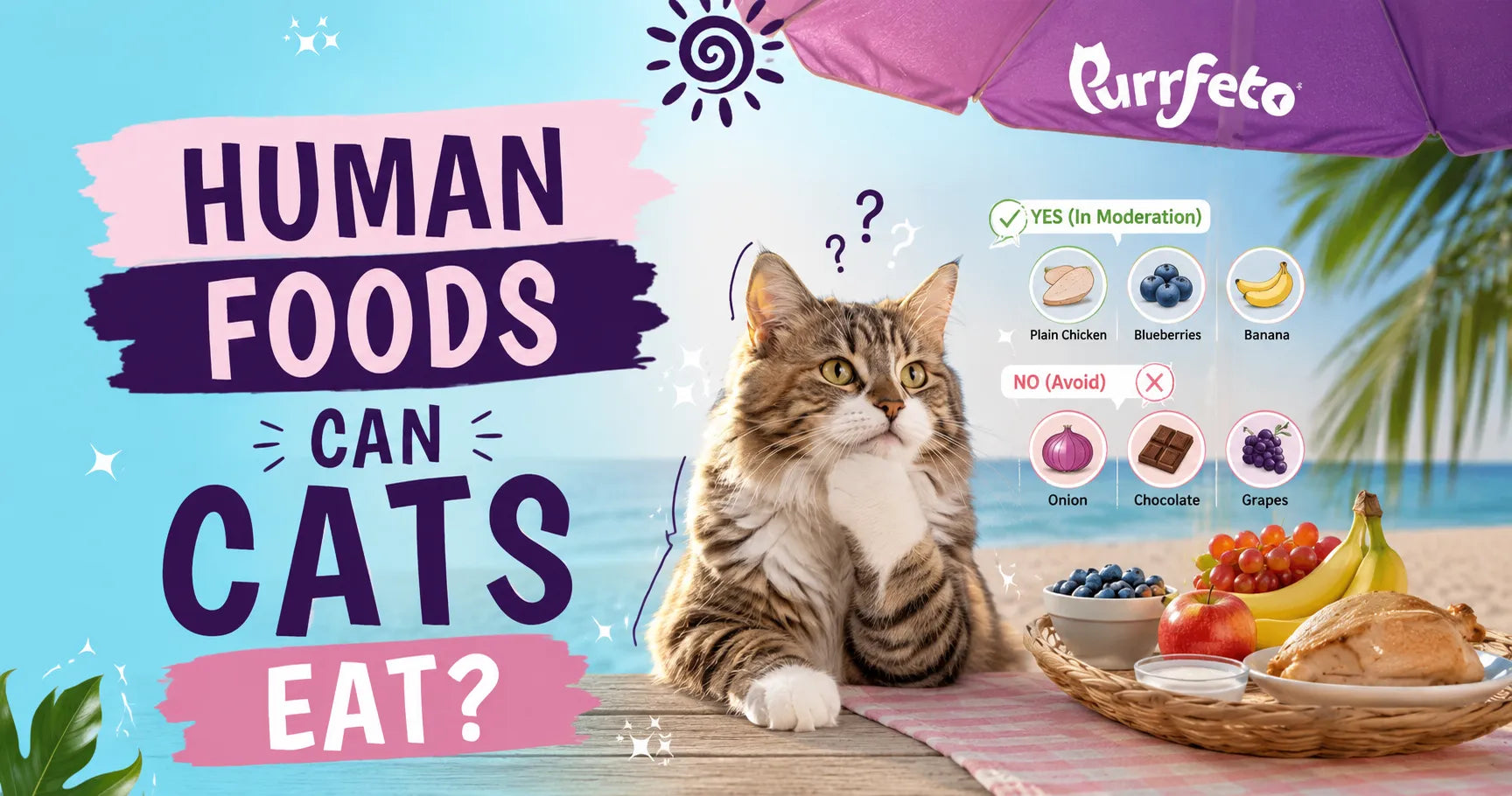
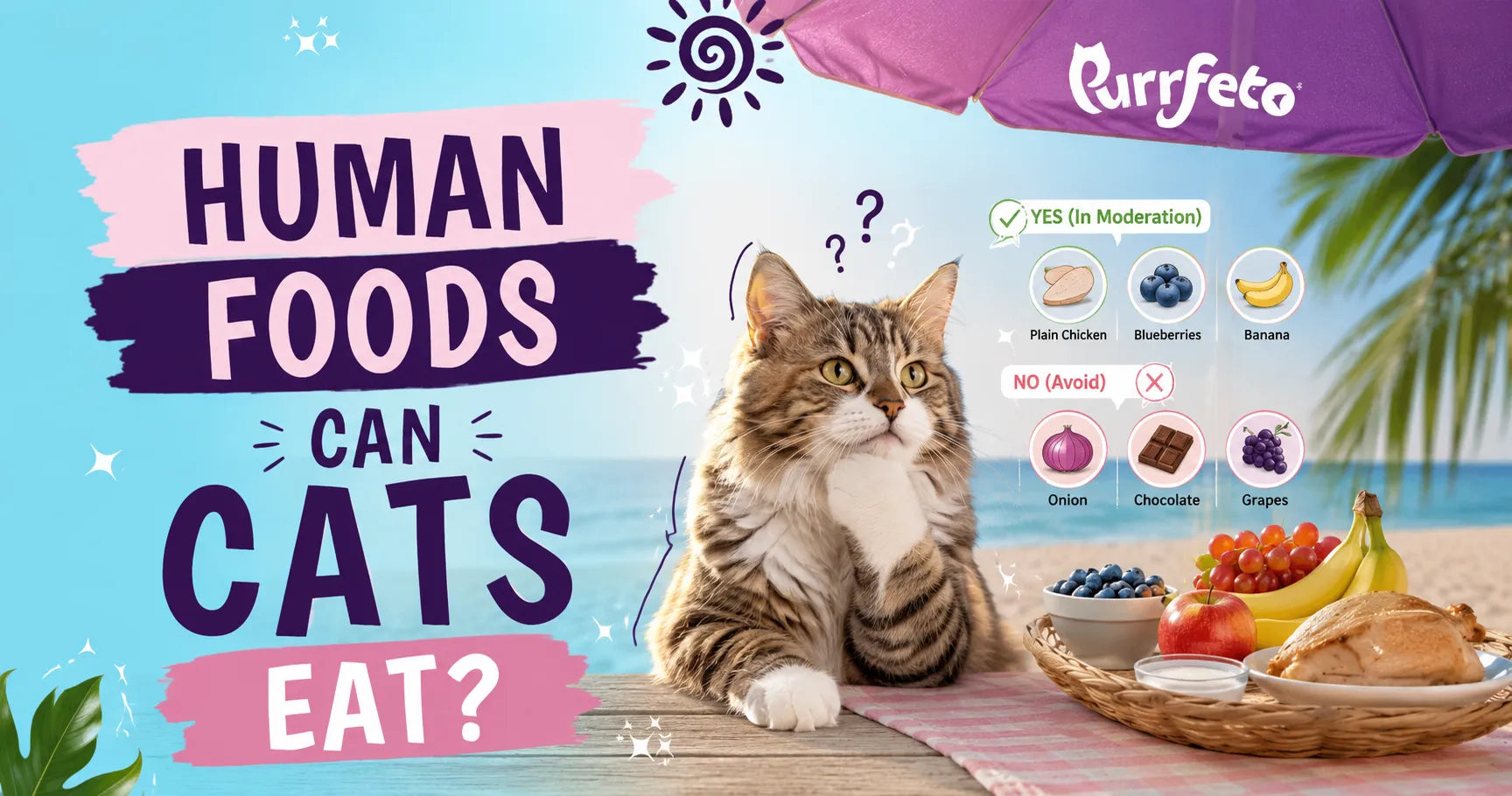
Cats can safely eat small amounts of plain cooked chicken, fish, eggs, rice, pumpkin, and a few select vegetables. They should never eat onion, garlic, chocolate, grapes, raisins, tamarind, alcohol, or anything spiced. Human food should stay under 10% of your cat's daily calories. The other 90% must come from a complete, balanced cat food, because cats need nutrients like taurine and vitamin A that home food cannot reliably provide.
Now, the details that actually matter in an Indian kitchen.
First, Understand Why Cats Need a Unique Diet
Your cat is an obligate carnivore. That is not a lifestyle choice; it is biology. Cats have evolved completely around eating whole prey, and they have lost the ability to make certain nutrients internally. They must get them, pre-formed, from animal tissue.
Here is what that means in practice:
- Taurine: Dogs and humans manufacture their own. Cats cannot make enough. A taurine shortfall over months leads to dilated cardiomyopathy, a heart condition, and irreversible retinal degeneration that causes blindness. Plant foods contain almost none of it.
- Vitamin A: Humans convert beta-carotene from carrots into vitamin A. Cats lack the enzyme. Carrots do nothing for them nutritionally.
- Arachidonic acid: An essential fatty acid cats can only get from animal fat.
- Arginine: A single arginine-deficient meal can cause a dangerous ammonia spike in cats. They have almost no reserve.
- Higher protein needs: Cats break down protein for energy continuously, even when fasting. Their baseline protein requirement is significantly higher than a dog's.
There is one more quirk that explains a lot of confusing behaviour: cats cannot taste sweetness. Every cat, from a house cat to a tiger, has a broken "sweet tooth" gene. Because this gene doesn't work, cats simply cannot taste sweetness at all.
So when your cat sneaks a lick of kheer or ice cream, it is not craving sugar. It cannot detect sugar. It is chasing the fat and dairy. This matters, because it means "my cat has a sweet tooth" is a myth, and every sweet thing you offer is pure empty calories with zero appeal to their actual senses.
If you want to go deeper on the single most important nutrient here, read our guide on why taurine matters in your cat's wet and dry food.
The 10% Rule, In Real Numbers
Vets recommend that treats and extras stay under 10% of daily calories. That sounds generous until you do the maths.
An average 4 kg neutered indoor adult cat needs roughly 200 kcal a day. Ten percent of that is 20 kcal.
Twenty kilocalories looks like this:
| Food | Amount that equals ~20 kcal |
| Boiled chicken breast, shredded | About 1 heaped tablespoon (12 g) |
| Boiled egg | One quarter of one egg |
| Plain cooked rice | About 1 tablespoon (15 g) |
| Paneer | A cube the size of your thumbnail (7 g) |
| Boiled fish, flaked | About 1 tablespoon |
Keep in mind, this is the total allowance for the whole day. It shouldn't be given with every meal, or doubled up when different family members feed them!
This is where most Indian households go wrong. Dad slips a piece of chicken at lunch. The kids share a bit of paneer at dinner. Grandma offers a saucer of cow’s milk, which, contrary to popular belief, causes severe diarrhea and stomach distress in most lactose-intolerant adult cats. Together, they can be 40% of the cat's daily intake, displacing the balanced food that carries the taurine, vitamin A, and minerals.
If your cat is filling up on extras and leaving its regular food, that is the warning sign. Our article on cat obesity, causes and weight loss tips covers what happens next.
Human Foods Cats Can Eat Safely

Everything below is safe only when it is plain, fully cooked, unsalted, unspiced, and served in small amounts.
Cooked chicken
The gold standard treat. Lean, highly digestible, and genuinely appealing to cats. Boil or steam it, no oil, no salt, no haldi, no ginger-garlic paste. Remove all skin and every bone. Shred it small.
Vets often recommend plain boiled chicken as part of a bland diet when a cat has an upset stomach.
Cooked fish
Fish is a genuine nutritional positive when handled correctly. It provides omega-3 fatty acids that support skin, coat, and joint comfort.
The rules:
- Always cooked, never raw: Raw fish contains thiaminase, an enzyme that destroys thiamine (vitamin B1). Thiamine deficiency in cats causes appetite loss, poor coordination, a distinctive downward neck bend, seizures, and can be fatal. Cooking destroys thiaminase.
- Deboned completely: Fish bones are fine and dangerous.
- Smaller fish are better: Sardines and mackerel sit low on the food chain and carry far less mercury than large predatory fish.
Also read Why cats love fish.
Cooked eggs
Excellent protein and B vitamins. Boil or scramble without oil, butter, salt, or masala.
Never serve raw eggs. Raw egg whites contain avidin, which binds biotin and blocks nutrient absorption, and raw eggs pose a high risk of Salmonella contamination. Always serve eggs fully cooked and plain. The bigger and more immediate risk with raw eggs is Salmonella. Cooking solves both problems at once.
Plain cooked rice
Safe, easily digestible, and commonly used in bland diets for short-term digestive upset. It provides calories but very little of what cats actually need, so treat it as a filler, not a food. A tablespoon at most.
We have a full breakdown here: Can cats eat rice, and how chicken and rice support a healthy cat diet.
Plain cooked pumpkin (kaddu)
A teaspoon of plain boiled or steamed pumpkin, with no sugar, no spices, no ghee, is a useful fibre source. Many vets suggest it for mild constipation or loose stool. Pure canned pumpkin puree works too, but check that it is not pumpkin pie filling, which contains sugar and spices.
Small amounts of cooked vegetables
Steamed carrot, green beans, peas, and cucumber are non-toxic. Chop them tiny to avoid choking. Be realistic though: most cats will sniff once and walk away, and they extract very little nutritional benefit. There is no need to add vegetables to a cat's diet.
Small amounts of certain fruits
Seedless watermelon, peeled apple with no seeds or core, banana, blueberries, and papaya are non-toxic in tiny quantities. Since cats cannot taste sweetness, most will not care. Skip fruit unless your cat genuinely enjoys it.
Prawns and shrimp
Cooked, peeled, deveined, unseasoned prawns are safe in small amounts, and many cats love them. Never raw. Watch for allergic reactions the first time.
The Indian Kitchen: What Your Cat Can and Cannot Share
This is the section that is missing from almost every article on this topic. Here is how the everyday Indian thali actually holds up.
Roti and chapati
A tiny plain crumb will not hurt. But roti is a refined carbohydrate with essentially zero value for a carnivore, and it fills a small stomach fast. Never with ghee, butter, jam, achaar, or sabzi. Keep it to an occasional crumb, not a daily habit.
Dal
Plain, unseasoned, unsalted boiled dal in a small spoon is not toxic. The problem is that real dal in a real Indian home almost never fits that description. It has hing, jeera, haldi, salt, and very often a tadka built on onion and garlic. Cooked dal from your kitchen is usually not safe to share.
Curd and dahi
Here is the nuance most people miss. Curd contains less lactose than plain milk because bacterial cultures ferment part of it during setting. That makes it less bad, not good. Plain unsweetened curd still contains roughly 3 to 4 grams of lactose per 100 grams, which is enough to upset most adult cats.
If your cat has never had dairy, do not start now. Half a teaspoon of plain curd occasionally will not poison a healthy cat, but there is no nutritional reason to offer it.
Milk
The single most persistent myth in Indian cat care.
Kittens produce plenty of lactase, the enzyme that digests milk sugar. After weaning at around eight weeks, lactase production drops sharply, and by adulthood most cats produce very little. Undigested lactose then pulls water into the intestines and ferments in the colon, producing gas, cramping, and diarrhoea, typically within 8 to 12 hours.
Cow's milk is also not a substitute for a mother cat's milk for orphaned kittens. The protein profile is wrong, the lactose level is wrong, and it lacks maternal antibodies entirely. Use a proper kitten milk replacer.
The saucer of milk is cultural, not nutritional. Full explanation here: Can cats drink milk? Myths vs facts, and what to give instead.
Paneer
Lower in lactose than milk and high in protein, so a thumbnail-sized cube of plain, unsalted, unfried paneer is unlikely to cause a problem in most cats. But it is dense in fat and calories. Restaurant or gravy paneer is off limits, because the gravy is built on onion, garlic, cream, and salt.
Ghee, butter, and oil
Not toxic, but high-fat foods can trigger vomiting, diarrhoea, and in some cases pancreatitis. Skip entirely.
Idli, dosa, poha, upma
Plain steamed idli in crumb quantity is harmless. But these are carbohydrate-heavy, and the accompanying sambar and chutney contain tamarind, chilli, hing, and often onion and garlic. Do not share the plate.
Fish curry, chicken curry, and biryani
The most dangerous everyday item on this list, precisely because it looks like it should be fine.
People reason: "It is just a piece of chicken." But that piece of chicken has been marinating in onion-garlic paste, salt, chilli, and oil for an hour. You are not feeding your cat chicken. You are feeding your cat concentrated allium in a chicken-shaped delivery vehicle.
If you want to give your cat meat from your kitchen, set a portion aside before the masala goes in.
Bones from your plate
Cooked bones become brittle and splinter. Chicken bones, fish bones, and mutton bones can lodge in the throat, perforate the stomach or intestines, or cause an obstruction that needs emergency surgery. This is one of the most common preventable emergencies in Indian veterinary clinics.
Toxic & Harmful Foods to Avoid

Why they matter: Some items are immediately toxic, while others cause severe health issues over time. Both pose a serious risk to your cat.
The Allium Group:
- Onions
- Garlic
- Leeks
- Spring onions
- Shallots
The most relevant toxin for Indian cats, by a wide margin.
Alliums contain organosulfur compounds, principally n-propyl disulfide, that cause oxidative damage to red blood cells. Damaged cells form Heinz bodies and get destroyed by the body, leading to haemolytic anaemia.
Three facts make this worse than most people assume:
- Cats are more sensitive than dogs: Feline haemoglobin has more sulfhydryl groups available for oxidative attack. In one dataset of reported toxic exposures, Allium species were the most common toxic factor in cats, accounting for 3.3% of all reported feline cases.
- The effect is cumulative: Small amounts repeated over days can do the same damage as one large dose. The daily "just a little gravy" habit is exactly the pattern that causes harm.
In cats, roughly 5 g/kg of onion is considered a risk threshold for a 4 kg cat, which is only 20 grams, which is a small piece of one onion.
The signs are delayed. Heinz bodies appear within about 24 hours, but visible anaemia often takes several days. Watch for lethargy, weakness, pale or white gums, and dark or reddish urine. Any suspected allium ingestion in a cat warrants a call to your vet.
Chocolate and cocoa
Contains theobromine and caffeine, both methylxanthines that cats metabolise very slowly. Dark chocolate and baking chocolate are far more concentrated than milk chocolate. Signs include vomiting, restlessness, rapid heart rate, tremors, and seizures.
Watch out for Indian sweets and desserts containing cocoa, and for chocolate left out during Diwali and Rakhi.
Grapes, raisins, and, importantly, tamarind
Grapes, raisins, and tamarind: These foods contain high levels of tartaric acid, which can trigger sudden, fatal acute kidney failure in cats even in tiny amounts.
Alcohol and raw dough
Even small amounts of alcohol can cause dangerous drops in blood sugar, body temperature, and blood pressure in a cat. Raw dough is a double threat: it expands in the warm stomach, and fermenting yeast produces ethanol internally.
Caffeine, chai, and coffee
The same methylxanthine family as chocolate. Cats are considerably more sensitive than people. Keep chai, filter coffee, cold coffee, and energy drinks out of reach.
Nuts
Macadamia nuts are specifically toxic. Beyond that, the fat and oil content in almonds, cashews, and walnuts causes digestive upset, and whole nuts are a choking and obstruction hazard. Skip all of them.
Xylitol and sugar-free sweeteners
Here I will be more precise than most articles on this topic, because the difference matters.
Xylitol toxicity is very well documented in dogs, where it triggers a massive insulin release, dangerous hypoglycaemia, and sometimes acute liver failure. In cats, the evidence is much thinner, and confirmed poisoning cases are rarely reported. Several veterinary sources state directly that cats do not appear to be at the same risk.
That does not make it safe. It means the honest position is "unproven in cats, and there is zero reason to feed it." Keep sugar-free gum, mints, diabetic sweets, and sugar-free peanut butter away from your cat.
Liver, in large or regular amounts
A small piece of cooked liver is fine. Liver as a staple is not. The Merck Veterinary Manual is explicit: feeding only liver can induce vitamin A toxicity in both dogs and cats. This causes painful bone changes, particularly in the neck and forelimbs. If kaleji is a regular feature of your cooking, keep the cat's share occasional and tiny.
Dog food
Not toxic, and one stolen mouthful is nothing to panic about. But dog food is formulated without adequate taurine, vitamin A, and arachidonic acid for feline needs. A cat fed dog food long term will develop deficiencies. If you have both, feed them separately.
Anything spicy, salty, or fried
Chilli, masala, salt, and fried food cause gastrointestinal irritation, vomiting, and diarrhoea. Cats have a much lower sodium tolerance than humans, and their kidneys are built for a low-sodium diet.
Quick Reference Table
| Food | Verdict | Notes |
| Boiled chicken, plain | Safe | No skin, no bones, no masala |
| Cooked fish, deboned | Safe | Never raw. Prefer sardine, mackerel |
| Cooked egg | Safe | Never raw egg white |
| Plain cooked rice | Safe in tiny amounts | Filler only, no nutrition |
| Plain pumpkin | Safe | A teaspoon, no sugar or spice |
| Cooked prawns | Safe | Peeled, deveined, plain |
| Roti or chapati | Occasional crumb | Empty calories |
| Plain curd | Small amount at best | Less lactose than milk, still risky |
| Paneer, plain | Tiny piece | High fat, high calorie |
| Cow's milk | Avoid | Most adult cats are lactose intolerant |
| Dal with tadka | Avoid | Usually contains onion, garlic, salt |
| Onion, garlic | Toxic | Cumulative. Cats are highly sensitive |
| Curry or biryani | Toxic | Masala base is the danger, not the meat |
| Chocolate | Toxic | Theobromine and caffeine |
| Grapes and raisins | Toxic | Kidney injury |
| Tamarind (imli) | Avoid | Tartaric acid, same as grapes |
| Alcohol, raw dough | Toxic | Emergency |
| Chai and coffee | Toxic | Methylxanthines |
| Nuts | Avoid | Fat, choking, macadamia toxicity |
| Cooked bones | Dangerous | Splinter and perforate |
| Raw meat or fish | Avoid | Bacteria, thiaminase |
| Dog food | Avoid long term | Taurine deficient for cats |
What To Do If Your Cat Eats Something Toxic
- Remove any remaining food and note what it was and roughly how much.
- Do not induce vomiting at home. Human remedies like salt water can cause serious sodium toxicity in cats.
- Call your vet immediately, even if your cat looks completely normal. Onion, garlic, and grape toxicity often show no symptoms for one to three days, and treatment works best when started early.
- Take the packaging or a photo of the dish with you.
- Watch for: vomiting, diarrhoea, lethargy, pale or white gums, loss of appetite, unusual thirst, dark or red urine, wobbliness, tremors, or hiding.
Persistent vomiting or diarrhoea after any dietary change is worth taking seriously. Our guides on why cats vomit and cat diarrhoea causes, and signs explain when to worry and when to wait.
The Part That Actually Keeps Your Cat Healthy
Everything above is about the 10%. The 90% is what determines whether your cat thrives or slowly declines.
A complete and balanced cat food exists to solve a problem that a home kitchen cannot solve reliably: hitting exact targets for taurine, vitamin A, arachidonic acid, arginine, calcium-to-phosphorus ratio, and a dozen trace minerals, in every single meal, every single day, for years. Miss taurine consistently and you get heart disease and blindness. Get the calcium ratio wrong, and you get bone disease. These failures are silent for months, then sudden.
This is exactly why complete cat food outperforms home-cooked meals even when the home cooking is done with love and good ingredients.
At Purrfeto, our recipes are built around Mediterranean-inspired flavours, formulated specifically for Indian cats and Indian conditions. A few options depending on where your cat is in life:
If your cat is a fish lover and you have been tempted to share the day's catch, Purrfeto Adult Dry Cat Food with Chicken and Sardine gives you the fish your cat wants without the mercury and thiaminase risk of feeding fish from your plate. Sardines sit low on the food chain, so they carry far less mercury than large fish.
If you have been feeding rice to bulk up meals, Purrfeto Adult Dry Cat Food with Chicken and Rice delivers the same familiar texture with the animal protein, taurine, and micronutrients that plain rice cannot provide.
If your cat drinks very little water, which is extremely common in Indian homes and a significant risk factor for urinary problems, wet food is the easiest fix. Purrfeto Adult Wet Cat Food with Mackerel in Gravy and Adult Wet Cat Food with Ocean Fish in Gravy build hydration into every meal. Our article on FLUTD and how diet reduces risk explains why this matters more than most people realise.
If you have a kitten, growth demands are roughly double an adult cat's, which is why sharing your food is riskiest at this stage. Purrfeto Dry Cat Food for Kitten with Chicken and Ocean Fish and Wet Food for Kitten with Ocean Platter in Jelly are formulated for that window. See kitten vs cat food for the differences.
If your cat is fussy, our 100g packs let you test a flavour before committing. You can browse the full Purrfeto range here.
Not sure whether to go wet, dry, or both? Our comparison of wet vs dry cat food breaks down the trade-offs.
The Bottom Line
Sharing food is how Indian families show affection. That instinct is not wrong. It just needs a filter.
Ask three questions before anything leaves your plate:
- Is it plain and fully cooked? No masala, no salt, no oil, no bones.
- Is it on the safe list? Chicken, fish, egg, rice, pumpkin. Not onion, garlic, chocolate, grapes, imli, or anything from a curry.
- Is it within the 10%? About a tablespoon a day, total, for the whole household.
Get those three right and the occasional shared bite is a small joy, not a risk. Keep the other 90% complete and balanced, and your cat gets the taurine, vitamin A, and protein that will actually decide how long and how well it lives.
For more on choosing the right food for your cat's life stage and health, read our complete guide to choosing healthy cat food, or explore the full Purrfeto range.
FAQs
Can cats eat rice and roti every day?
No. Both are safe in tiny occasional amounts, but they are carbohydrate fillers with almost no feline nutritional value. Fed daily, they displace the protein and taurine your cat actually needs.
Can cats drink milk?
Most adult cats cannot digest it. Lactase production drops sharply after weaning, so milk commonly causes gas, cramping, and diarrhoea within 8 to 12 hours.
Is curd safer than milk for cats?
Slightly, because fermentation reduces the lactose, but plain curd still holds around 3 to 4 grams of lactose per 100 grams, which is enough to upset most cats. It is less bad, not good.
Can you give your cat chicken from your curry?
No. The chicken has absorbed onion-garlic paste, salt, chilli, and oil. Set aside a plain portion before adding masala.
How much human food can a cat have per day?
Under 10% of daily calories. For a typical 4 kg adult cat, that is about 20 kcal, roughly one tablespoon of boiled chicken or a quarter of a boiled egg.
Are eggs safe for cats?
Yes, when fully cooked and plain. Raw egg white contains avidin, which blocks biotin absorption, and carries Salmonella risk.
Can cats eat tuna every day?
No. Regular tuna feeding risks mercury accumulation, vitamin E depletion leading to steatitis (a painful inflammation of body fat), and a behavioural problem vets call the "tuna junkie," where cats refuse all other food. A teaspoon once or twice a week is the general limit for plain tuna. A properly formulated tuna recipe like Purrfeto Adult Wet Cat Food with Tuna Platter in Jelly is a different product entirely, since it is supplemented and balanced.
Is tamarind safe for cats?
No. Tamarind is high in tartaric acid, identified by the ASPCA as the likely toxic principle behind grape and raisin kidney injury. Keep imli-based dishes away from your cat.
Can cats eat paneer?
A thumbnail-sized piece of plain, unsalted, unfried paneer is unlikely to cause harm. Gravy paneer is not safe, because the gravy contains onion, garlic, cream, and salt.
What should you feed a stray cat?
Plain boiled chicken, plain cooked fish with all bones removed, or plain cooked rice mixed with meat. Fresh water always. Never milk, never leftovers from a spiced meal. A 100g pack of complete cat food is an affordable and far better option.
This article is for general information. It is not a substitute for veterinary advice. If you suspect your cat has eaten something toxic, contact your veterinarian immediately.
 Back to Blogs


