
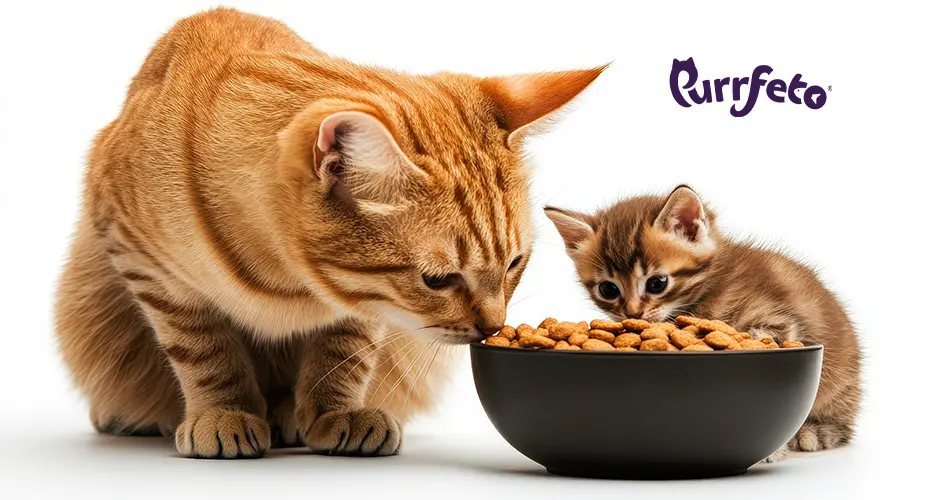
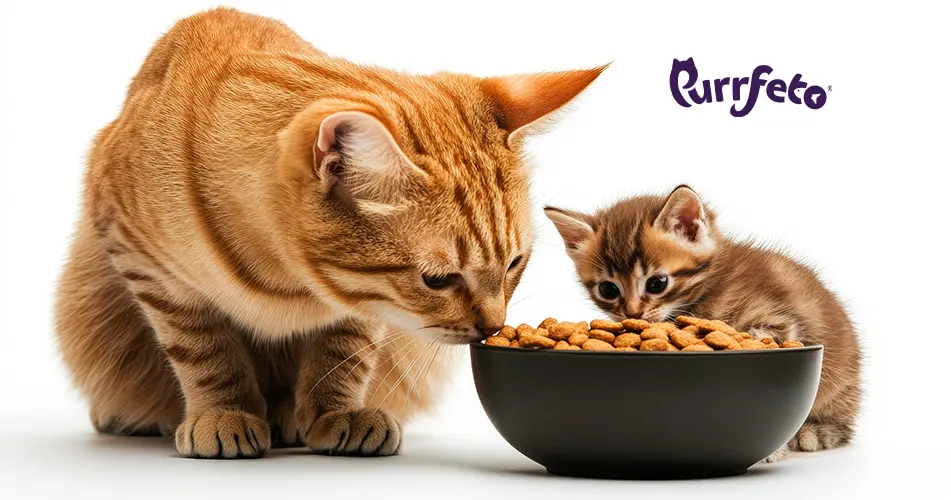
Kitten food and adult cat food are not the same product in a different bag. Kitten food carries more protein, more calories per gram, more calcium and phosphorus, and added DHA for brain and eye development. Adult cat food is built to keep a grown cat steady, not to grow one. Most kittens move to adult food at around 12 months, and large breeds like Maine Coons often stay on kitten food until 18 to 24 months.
If you read nothing else, read that. Everything below explains why and what to do in a real Indian home where one cat is nine weeks old, the other is four years old, and both eat from the same floor.
Why Two Different Foods Exist at All

A kitten is not a small cat. It is a construction site.
In its first year, a kitten multiplies its birth weight many times over while building bone, muscle, brain tissue, retina, and an immune system from scratch. An adult cat is doing none of that. It is running maintenance: replacing tissue, powering daily activity, and holding a steady weight.
Those are two completely different engineering problems, and pet food is formulated for one or the other.
Global nutrient standards make this official. Under the AAFCO cat food nutrient profiles, foods made for growth and reproduction must contain at least 30% protein on a dry matter basis, while adult maintenance foods need a minimum of 26%. That gap is only the headline. The real differences run deeper.
The 7 Real Differences Between Kitten Food and Cat Food

|
What changes |
Kitten food |
Adult cat food |
Why it matters |
|
Protein minimum |
30% dry matter |
26% dry matter |
Growing tissue needs raw building blocks |
|
Calorie density |
High |
Controlled |
A kitten eats a tiny volume and must extract a lot from it |
|
DHA and EPA |
Required for growth |
Not specified |
Brain, retina, and nerve development |
|
Calcium and phosphorus |
Higher, tightly ratioed |
Lower |
The skeleton is being built, not maintained |
|
Vitamins and trace minerals |
Denser per calorie |
Maintenance level |
The immune system is still forming |
|
Kibble size and texture |
Smaller, easier to crunch |
Standard |
Kitten jaws and milk teeth are small |
|
Meals per day |
3 to 4 |
2 |
Tiny stomach, huge daily requirement |
1. Protein does more than build muscle
In a kitten, dietary protein becomes leg bone, heart muscle, whiskers, retina, and antibodies. Growing kittens are also more sensitive to the quality of dietary protein and to amino acid balance than adult cats are. Two foods can both say "30% protein" and behave differently in the body, because a highly digestible animal protein delivers usable amino acids while a heavily plant-loaded protein does not.
This is why the ingredient list matters as much as the percentage. Named animal proteins in the first few ingredients are the signal you want.
2. Calorie density is the difference most people miss
This is the single most underrated number in the entire kitten vs cat food debate.
A kitten's stomach is roughly the size of a marble. It cannot eat volume. So the food must be calorie-dense, or the kitten physically cannot consume enough to grow.
The scale of the gap is startling. A kitten at 10 weeks of age needs around 200 kcal per kilogram of body weight per day, compared with about 80 kcal per kilogram per day at 10 months. A healthy adult cat sits lower still, in the region of 50 to 70 kcal per kilogram.
Same species. Roughly three to four times the energy demand per kilo. That is what "kitten food" is really solving.
3. DHA is the nutrient nobody talks about
Under the current AAFCO profiles, growth and reproduction diets carry a minimum requirement for EPA plus DHA combined at 0.012% of dry matter, along with alpha-linolenic acid at 0.02%. For adult maintenance, no value is set.
That single line tells you the whole story. These omega-3 fatty acids are considered necessary while the brain and retina are being built, and optional once the building is finished. Fish-based recipes are a natural fit here, which is why ocean fish and sardine recipes do well in kitten formulas.
4. Calcium and phosphorus are about the skeleton, not strength
Growth profiles specify higher calcium and phosphorus than maintenance profiles, and both profiles hold the calcium-to-phosphorus ratio between 1:1 and 2:1. Ratio matters more than raw quantity. A kitten fed a diet with the wrong balance can end up with poorly mineralised bone even when total calcium looks adequate on paper.
This is also the reason home-cooked chicken and rice fails kittens so badly. Muscle meat is high in phosphorus and low in calcium, which pushes the ratio in exactly the wrong direction during the one year it matters most.
5. Micronutrient density scales with calories, not with grams
Nutrient profiles are expressed per unit of energy. Because a kitten eats fewer grams but needs more nutrients, kitten food packs vitamins and trace minerals more tightly per gram of food. Feeding adult food to a kitten does not just shortchange it on protein. It quietly shortchanges it on crucial growth nutrients like zinc, copper, calcium, phosphorus, and overall caloric density.
6. Kibble is a physical product, not just a nutritional one
Kitten kibble is smaller, often slightly softer, and shaped for milk teeth and small jaws. A kitten trying to eat large adult kibble will frequently swallow pieces whole, gag, or simply eat less than it needs. Purrfeto's kitten dry range is built at kitten scale for this reason, and it is worth checking the physical kibble in any brand you buy before you commit to a large bag.
7. Meal frequency is part of the formula
Adult cats do fine on two meals. Kittens under six months need three to four meals because they cannot hold a day's worth of calories in one sitting. Feeding schedule and food type are a package. Buying kitten food and then feeding it twice a day undoes part of the benefit.
What Actually Happens If You Feed the Wrong One
Here is where most articles either panic you or wave it off. The truth sits in between, and it depends entirely on which direction the mistake goes.
Kitten eating adult food

Occasionally: harmless. Your kitten steals from the older cat's bowl; you will not see a problem.
As the main diet, for weeks or months, this is the one to take seriously. The likely outcomes are slower growth, a duller coat, lower energy, a weaker immune response, and a skeleton built on a thin nutrient budget. Growth is a one-time window. You do not get a second attempt in month four.
Watch for a pot-bellied look with visible spine and ribs, patchy or dull coat, lethargy between play bursts, or a kitten that eats constantly and still does not gain weight. Any of these deserves a vet visit rather than a bigger bowl.
Adult cat eating kitten food
Occasionally, also harmless.
Long-term: this is a slow weight problem, not an emergency. Kitten food is calorie-dense by design. An adult cat, especially a neutered indoor cat in a Mumbai or Bengaluru flat, will gain on it. Weight gain in cats is not cosmetic. It raises the risk of diabetes, arthritis, and urinary tract disease, and Purrfeto has a full breakdown in its guide to cat obesity, causes, and weight loss.
The exception: vets sometimes deliberately put an underweight, recovering, or pregnant cat on kitten food precisely because of the calorie density. If your vet says so, follow your vet, not a blog. Pregnant and nursing queens fall under the same growth and reproduction profile as kittens, which is covered in the pregnant cat care guide.
Reading an Indian Cat Food Label (The Part Most Guides Skip)
This section matters more in India than almost anywhere else, and here is why.
Pet food labelling in India is guided by the Bureau of Indian Standards through IS 11968:2019, which covers ingredient quality, nutrient profiles, hygiene and labelling requirements. That standard is currently voluntary rather than mandatory, which means label quality varies considerably between brands sold here. The Department of Animal Husbandry and Dairying (DAHD) oversees livestock safety and animal feed imports, rather than a single dedicated pet food statute.
Translation for a pet parent: the front of the pack is marketing. The back of the pack is evidence. Learn to read the back.
The dry matter trick that changes everything
Guaranteed analysis figures are printed "as fed", meaning water is included. To compare any two foods fairly, you have to strip the water out.
The formula is simple:
Dry matter % = as-fed % ÷ (100 − moisture %) × 100
Run it on real numbers. Purrfeto's kitten dry food with chicken and ocean fish declares 30% minimum crude protein and 12% minimum crude fat. Dry kibble typically holds around 8 to 10% moisture, so on a dry matter basis, that is roughly 33% protein, comfortably clearing the 30% growth minimum.
The adult version of the same recipe declares 28% minimum protein, which lands near 31% dry matter, above the 26% adult requirement.
Now do it for wet food, where the result surprises everyone. The kitten wet food in Ocean Platter Jelly shows 6% protein against a maximum of 89.5% moisture. Strip the water, and that 6% becomes roughly 57% protein on a dry matter basis.
A pouch that looks weak on the label is actually protein-dense. It is just mostly water, which is the entire point of wet food.
Your 60-second label check
- Life stage statement: Does it say kitten or growth, or adult or maintenance? If it says neither, be cautious.
- First three ingredients: Named animal proteins should be near the top.
- Taurine, declared by name: Cats cannot make enough of it, and deficiency causes heart disease and irreversible blindness. Purrfeto declares 1000 mg per kg across both its kitten and adult dry recipes. There is more on this in the section on why taurine matters in wet and dry cat food.
- Crude protein, fat, fibre, ash, or moisture: Run the dry matter maths if you are comparing brands.
- Manufacturing and packing date: In heat, freshness is a nutrition issue, not a formality.
The Kitten Feeding Timeline, Month by Month
|
Age |
Food stage |
Meals per day |
What is happening |
|
0 to 4 weeks |
Mother's milk or kitten milk replacer |
On demand |
No solid food, no cow's milk, ever |
|
3 to 5 weeks |
Weaning begins |
4 to 5 |
Kittens can start weaning onto balanced kitten food from 3 to 5 weeks |
|
6 to 12 weeks |
Full kitten food |
4 |
Peak growth. Roughly 100 g gain per week |
|
3 to 6 months |
Kitten food |
3 |
Teething, huge energy demand |
|
6 to 12 months |
Kitten food |
2 to 3 |
Growth slowing, neutering usually happens here |
|
12 months |
Transition to adult |
2 |
Switch over 7 to 10 days |
|
12 to 24 months |
Adult, or kitten if a large breed |
2 |
Maine Coons, Ragdolls, and Norwegian Forest Cats mature later |
Newborn and orphaned kittens are their own subject entirely, and the week-by-week newborn kitten care and feeding guide covers bottle feeding, warmth, and toileting.
Never give cow's milk to a kitten or an adult cat. Most cats lose the enzyme needed to digest lactose after weaning, and it causes diarrhoea in an animal that can barely afford the fluid loss. The milk myths versus facts guide walks through the alternatives.
How Much to Feed: Calories First, Grams Second
Use the packet's feeding chart as your starting point, then adjust to the cat in front of you. If you want to sanity-check the packet, here is the vet arithmetic.
Resting Energy Requirement (RER) = 70 × (body weight in kg)^0.75
Then multiply:
- Kitten under 4 months: RER × 2.5
- Kitten 4 to 12 months: RER × 2.0
- Neutered adult, indoor: RER × 1.2 to 1.4
|
Body weight |
Life stage |
Approx. daily calories |
|
0.5 kg |
Kitten under 4 months |
100 to 110 kcal |
|
1 kg |
Kitten under 4 months |
170 to 180 kcal |
|
1.5 kg |
Kitten under 4 months |
230 to 240 kcal |
|
2 kg |
Kitten 4 to 12 months |
230 to 240 kcal |
|
3 kg |
Kitten 4 to 12 months |
310 to 320 kcal |
|
3 kg |
Adult, neutered |
190 to 225 kcal |
|
4 kg |
Adult, neutered |
240 to 280 kcal |
|
5 kg |
Adult, neutered |
280 to 330 kcal |
To convert calories into grams, divide the daily calorie target by the food's calories per gram. Most dry cat foods sit somewhere around 350 to 400 kcal per 100 g, so a 4 kg neutered adult needing 260 kcal lands near 65 to 75 g of kibble a day.
Weigh it. Do not eyeball it. A kitchen scale is the cheapest health intervention you will ever buy for a cat.
Where wet food fits into the maths
Wet pouches are mostly water by design, which is their strength. Purrfeto's 80 g pouches carry up to 87% moisture and support hydration and urinary health, but they carry relatively few calories per pouch.
So use them as intended. Pair a pouch with kibble rather than expecting a couple of pouches to cover a growing kitten's full energy load. A practical routine looks like this: kitten kibble as the calorie base, one kitten wet pouch a day for hydration and palatability. For adults, the same logic applies to mackerel in gravy or tuna platter in jelly pouches. The full comparison is between wet vs dry cat food.
The Neutering Curveball Nobody Warns You About
This is the section that will save more Indian cats from obesity than any other advice on this page.
Most cats are neutered between six and eight months. That falls squarely inside the kitten food window. Your cat is still growing, still on calorie-dense kitten food, and its metabolism has just changed underneath it.
The evidence is consistent. Food intake in cats fed freely increases after neutering, and intake generally needs to be reduced by 20 to 30% to prevent weight gain. Veterinary nutrition guidance recommends cutting caloric intake by around 30% after spaying or neutering, then adjusting to maintain a lean body condition.
What to do: do not switch your kitten to adult food early just because it has been neutered. It still needs growth nutrition. Instead, keep the kitten food and trim the portion by roughly 20 to 25%, then reassess body condition every two weeks. If your cat is thickening around the ribs at nine months, portion size is the lever, not food type.
Purrfeto's neutering guide covers costs and recovery in the Indian context.
Two Bowls, One House: Feeding a Kitten and an Adult Together

This is the most common real-world problem in homes, and "just feed them separately" is useless advice when you live in a 2BHK.
Here is what actually works.
Separate rooms, timed meals: Feed both cats at the same time in different rooms with the doors shut. Ten minutes, then pick up whatever is left. This alone solves 80% of cases.
Height separation: Adults jump; young kittens under about four months often cannot. Put the adult's bowl on a shelf or windowsill, and the kitten's on the floor. Reverse it once the kitten can jump.
The 100 g test pack: If you have never fed either cat a new brand before, buy the 100 g kitten trial pack and the 100 g adult trial pack at Rs 40 each before committing to a 3 kg bag. Cats are opinionated. Test cheaply.
Same brand, different life stage: Keeping both cats within one brand family means similar palatability and a similar ingredient base, which makes accidental cross-eating less disruptive and makes your own portion tracking simpler.
Do not solve it with all-life-stage food unless your vet recommends it. All life-stage formulas are built to the growth profile, which means your adult cat is eating kitten-grade calories permanently.
If you are still in the introduction phase, how to introduce a cat to another cat covers the behavioural side.
Making the Switch: The 10-Day Transition
At around 12 months, most cats are ready. The signals are a stable weight over several weeks, a settled body shape, and calmer energy patterns rather than pure growth spurts.
|
Days |
Old food |
New food |
|
1 to 3 |
75% |
25% |
|
4 to 6 |
50% |
50% |
|
7 to 9 |
25% |
75% |
|
10 |
0% |
100% |
For sensitive stomachs, stretch it to 14 days and move in 15% steps instead. Cats with a history of loose stools and cats who have recently moved house or been to the vet do better on the slow lane.
Rules that make it work:
- Change one thing at a time. Not the food, the bowl, and the feeding spot together.
- Mix thoroughly. Cats will pick around new kibble if you layer it.
- Keep fresh water within a few steps of the bowl but not directly beside it. Many cats dislike water next to food.
- Soft stool for a day or two is normal. Diarrhoea for more than 48 hours, vomiting, or refusal to eat means stop and call your vet.
If digestion is your recurring worry, improving your cat's digestion naturally goes deeper.
Practical switch: move from kitten dry with chicken and ocean fish to the adult version of the same recipe. Same protein sources, same flavour family, minimal shock to the palate. If your cat has always preferred the chicken and rice kitten recipe, its adult counterpart is the smoothest handoff.
The India Problem: Heat, Humidity, and Bag Size
Nobody writing about kitten vs cat food from a temperate country will tell you this, and it is a real nutrition issue.
Dry cat food is coated in fat for palatability. Fat oxidises. Oxidation accelerates sharply with heat and moisture, and oxidised fat degrades the fat-soluble vitamins A, D, E, and K that the food is supposed to deliver. Storage guidance is to keep dry food in a cool, dark place and keep humidity below 60% to prevent mould and bacterial growth. Kibble also starts changing the moment it is exposed to air, and storage above roughly 27°C in humid conditions speeds up the process.
Now look at a Chennai kitchen in July, or a Delhi flat in May.
How to store cat food in Indian conditions

- Keep the original bag: It has a fat and oxygen barrier. Put the whole bag inside your airtight container rather than tipping the kibble in loose.
- Buy for four to six weeks, not for six months: This is the important one.
- Squeeze the air out before sealing: Air is the enemy, not just moisture.
- Never store on the floor or near the stove: Interior cupboard, away from sunlight.
- Smell test at every refill: Stale, sour, bitter, or paint-like means throw it out.
- Wash the container between bags, not just between refills. Old fat residue turns new kibble rancid faster.
The pack size decision, with the actual maths
|
Pack |
Price |
Cost per kg |
Best for |
|
Rs 40 |
Rs 400 |
Testing acceptance before you commit |
|
|
Rs 440 |
Rs 367 |
One kitten, or peak summer and monsoon |
|
|
Rs 1,030 |
Rs 343 |
Two cats, or cooler months |
|
|
Rs 2,180 |
Rs 311 |
Multi-cat homes and rescue feeders with cool, dry storage |
The 7 kg bag is the best value per kilogram, and it is the wrong choice for a single cat in a humid coastal city. A cat eating 65 g a day takes over 100 days to finish 7 kg. That bag will be past its best long before the bowl is empty. Buy the size you will finish in a month, and let value follow freshness instead of the other way round.
Rough monthly cost, one cat: a 4 kg adult on roughly 65 g a day of the 3 kg adult pack works out to about Rs 22 a day, close to Rs 650 a month. Add one 80 g wet pouch daily at Rs 50, and you are near Rs 2,150 a month for a dry plus wet routine.
Feeding Mistakes That Are Specific to Homes
These come up again and again in Indian pet groups, vet clinics, and community feeding circles.
- Milk: Still the single most persistent myth. Veterinarians surveyed on International Cat Day noted that adult cats lack the enzymes to digest lactose, and that most cats are lactose intolerant.
- Rice, roti, and dal as a base: Cats produce no salivary amylase and are obligate carnivores. Small amounts of rice inside a balanced recipe are fine, which is why chicken and rice formulations exist, but rice as the main meal is calories without nutrition. The nuance is covered in can cats eat rice.
- Dog food in a cat bowl: Common in multi-pet homes and in community feeding. Dog food is not taurine-adequate for cats, and prolonged feeding risks heart disease and blindness. Never a substitute, not even briefly.
- Assuming home food is enough: In a national Indian survey conducted by Eval360 Research with veterinary bodies, 88% of vets said home-cooked food does not meet a cat's nutritional needs. It is not a question of love or effort. It is a question of taurine, vitamin D3, calcium, and the calcium-to-phosphorus ratio, which are almost impossible to hit consistently in a home kitchen. More on this is why cat food beats home-cooked meals.
- Leftover fish curry: Salt, oil, onion, garlic, and masala are all problems, and onion and garlic are actively toxic to cats.
- Free feeding an unlimited bowl: Convenient in a busy Indian household, and the fastest route to an overweight neutered cat.
- Brand hopping every month: Constant switching keeps the gut unsettled. Pick a life-stage-appropriate food and stay with it unless there is a reason to change.
How to Tell the Food is Working
Stop trusting the bowl and start reading the cat. Check these once a fortnight.
Body condition: Run your palms along the ribs. You should feel them under a thin layer, like the back of your knuckles. Looking down from above, there should be a visible waist behind the ribs. Ribs you can see from across the room mean underfed. Ribs you cannot find at all mean overfed.
Weight trajectory: A young kitten should gain steadily, roughly 100 g a week in the peak months. A healthy adult should stay flat. A kitten that stops gaining, or an adult that gains, is telling you something before any symptom does.
Coat: Glossy and smooth is a nutrition signal. A dull, dry, greasy, or thinning coat often shows up before anything else. Omega-3 and omega-6 fatty acids do most of that work, which is why fish-inclusive recipes like chicken and salmon and chicken and sardine suit coat-sensitive cats.
Stool: Firm and formed. Consistently loose or hard and infrequent means the diet or the hydration needs adjusting.
Litter tray behaviour: Straining, frequent small urinations, or crying in the tray needs same-day veterinary attention. Diet plays a real role in urinary health, as explained in " What is FLUTD in cats.
Energy: Kittens are chaos in bursts, then dead asleep. That is normal. Flat all day is not.
Call your vet, not a search engine, if you see sudden weight loss, appetite loss beyond 24 hours in a kitten, repeated vomiting, blood in stool, bumping into furniture, or difficulty passing urine.
The Purrfeto Range at a Glance
Both life stages are built on the same nutritional philosophy, with the formulation adjusted where growth demands it.
|
|
Kitten range |
Adult range |
|
Crude protein (min, dry) |
30% |
28% |
|
Crude fat (min, dry) |
12% |
12% |
|
Taurine |
1000 mg/kg |
1000 mg/kg |
|
Dry recipes |
Chicken & Ocean Fish, Chicken & Rice |
Chicken & Ocean Fish, Chicken & Rice, Chicken & Salmon, Chicken & Sardine |
|
Wet pouches (80 g) |
Ocean Platter in Jelly |
Mackerel in Gravy, Ocean Fish in Gravy, Tuna Platter in Jelly |
|
Pack sizes |
100 g, 1.2 kg, 3 kg, 7 kg |
100 g, 1.2 kg, 3 kg, 7 kg |
|
Also includes |
Psyllium husk for hairball control, cranberries for urinary support, omega-3 and omega-6, vitamins A, D3, and E |
Same, tuned for maintenance |
Purrfeto is formulated in India for Indian cats and Indian conditions, and is available on the Purrfeto store as well as Amazon, BigBasket, Zepto, Swiggy Instamart, and Supertails.
If you are unsure where to start, the guide to choosing healthy cat food walks you through the decision from scratch.
The Bottom Line
Kitten food versus cat food is not a marketing split. It is the difference between building a body and maintaining one.
Keep your kitten on growth nutrition for the full first year. Switch at 12 months, slowly, over 10 days. Adjust the portion after neutering instead of switching food early. Buy pack sizes your cat will finish in a month, because Indian humidity is part of your cat's nutrition, whether you account for it or not. And read the back of the pack, not the front, because in India the label standard is still voluntary.
Get that one year right, and you are not just feeding a cat. You are setting the ceiling on how well it lives for the next fifteen.
Browse the full Purrfeto kitten and adult range, and start with a 100 g trial pack if your cat is new to the brand.
FAQs
What is the main difference between kitten food and cat food?
Kitten food is denser in everything: more protein, more calories per gram, more calcium and phosphorus, and added DHA for brain and eye development. Adult cat food maintains a fully grown cat at a steady weight. Growth formulas require a minimum of 30% protein on a dry matter basis, and adult formulas require a minimum of 26%.
Can a kitten eat adult cat food?
Not as its regular diet. An occasional stolen mouthful is harmless. Fed consistently, adult food leaves a kitten short on calories, protein density, DHA, calcium, and micronutrients during the only year it gets to grow.
Can an adult cat eat kitten food?
Occasionally, yes. Long-term, it usually causes weight gain because kitten food is calorie-dense. Vets sometimes prescribe kitten food deliberately for underweight, recovering, pregnant, or nursing cats.
At what age should you switch your kitten to adult cat food?
Around 12 months for most cats. Large breeds such as Maine Coons, Ragdolls and Bengals often stay on kitten food until 18 to 24 months because they keep growing longer.
How many times a day should a kitten eat?
Four meals a day from 6 to 12 weeks, three meals from 3 to 6 months, and two to three meals from 6 to 12 months. Adult cats do well on two meals a day.
How do you switch food without upsetting your kitten's stomach?
Move gradually over 10 days: 25% new food for three days, 50% for three days, 75% for three days, then 100%. Extend to 14 days for sensitive cats.
Is wet or dry food better for a kitten?
Both work. Dry food carries the calorie load efficiently and supports chewing. Wet food supplies hydration, which matters because cats have a naturally low thirst drive. Many Indian pet parents get the best of both by using kibble as the base and one wet pouch a day.
Should you feed your kitten differently after neutering?
Yes, but change the portion, not the food. Keep it on kitten food to finish growing, and reduce the daily amount by roughly 20 to 25%, since energy needs drop and appetite usually rises after the procedure.
Can you feed your kitten and adult cat the same food?
Only if you use an all-life-stages formula, and even then, it is a compromise, because your adult cat ends up on growth-level calories. Separate life-stage foods with timed, separated meals is the better system.
Is cow's milk safe for kittens?
No. Most cats cannot digest lactose, and cow's milk commonly causes diarrhoea. Kittens without a mother need a proper kitten milk replacer, never cow's milk.
Why does your kitten's wet food say only 6% protein?
Because the figure includes water. Wet food is close to 89% moisture. Strip the water out, and the same pouch works out to be near 57% protein on a dry matter basis. Always compare foods on a dry matter basis.
Is BIS certification compulsory for cat food?
No. IS 11968:2019 is currently a voluntary standard, which is exactly why reading the analytical information and ingredient list yourself matters so much in the Indian market.
How much cat food should you buy at once?
Enough for four to six weeks. Larger bags cost less per kilogram, but in Indian heat and humidity, the fat in kibble oxidises, and the food loses quality before a single cat can finish a very large pack.
How much does feeding a cat cost per month?
Roughly Rs 650 to Rs 750 a month for a dry-only routine for one adult cat, and around Rs 2,100 a month if you add a wet pouch daily. Kitten feeding runs slightly higher because kittens eat more per kilogram of body weight.
 Back to Blogs


