
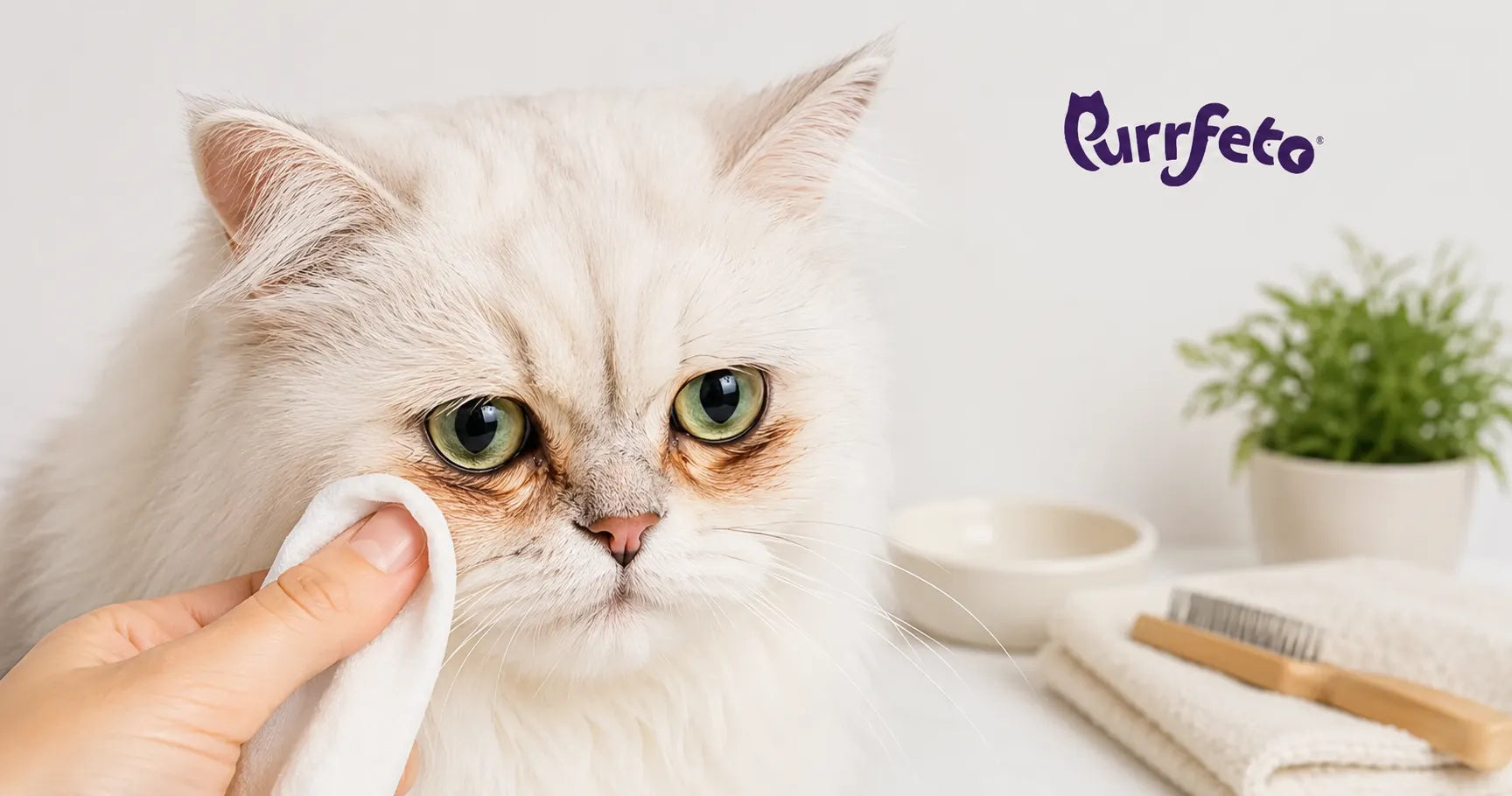
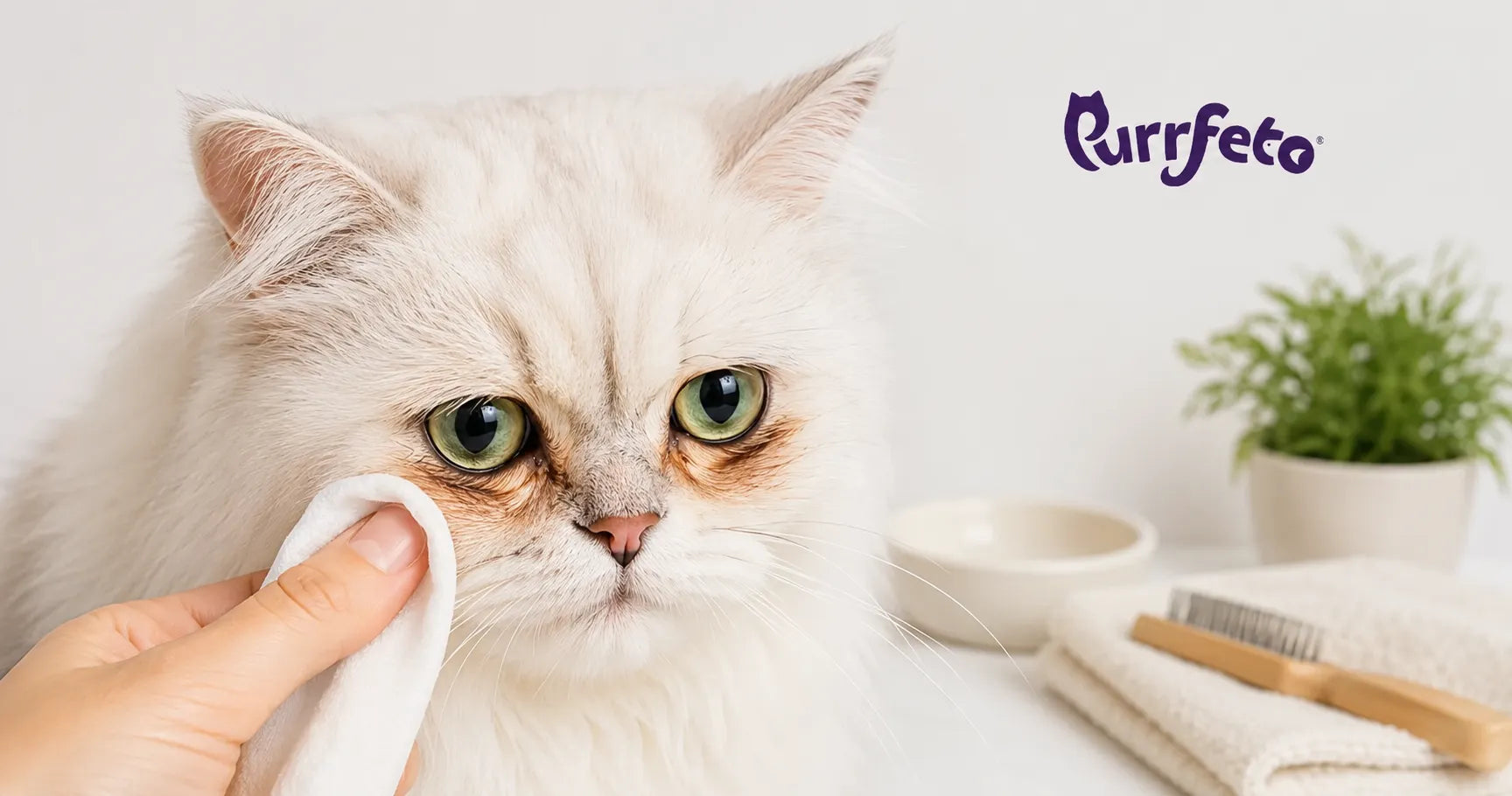
Cat tear stains are the rust coloured marks under a cat's eyes. The colour comes from porphyrin, an iron-based pigment released when the body breaks down old red blood cells. Porphyrin sits in tears. When tears spill onto fur instead of draining away through the tear duct, the pigment oxidises in air and turns reddish-brown. So a tear stain is not a stain that landed on your cat. It is your cat's own tears, left sitting on fur for too long. Fixing it means fixing two separate things: why the tears are overflowing and how long they stay on the face.
If you have a Persian, a Himalayan, an Exotic Shorthair, or a Persian mix in India, you have probably already tried three shampoos, two wipes, and a bottle of something from a pet shop, and the marks are still there. This guide explains why, in plain language, and what genuinely moves the needle.
What Tear Stains Actually Are
Every healthy cat produces tears all day. Tears wash out dust, keep the cornea smooth, and carry a small amount of waste pigment called porphyrin. Normally, these tears drain out of the inner corner of the eye, down a narrow tube called the nasolacrimal duct, and quietly into the nose. Your cat swallows them without you ever knowing.
Tear stains appear when the drainage system fails or when the eye is producing far more tears than the drain can handle. The medical word for that overflow is epiphora. The tears roll down the face instead, soak into the fur below the inner corner, and the porphyrin oxidises on contact with air, exactly the way iron rusts.
This is why two things are true at the same time, and why most people get stuck:
- The stain you see today is old news. It is already oxidised into the hair shaft.
- The overflow causing tomorrow's stain is still happening.
You cannot scrub your way out of problem two. And you cannot undye hair that is already stained. Understanding this saves months of frustration, which we will come back to.
Read the Stain Before You Treat It
The colour and smell of the discharge tell you more than any product label. This is the single most useful check you can do at home, and it takes ten seconds.
|
What you see and smell |
What does it usually mean |
What to do |
|
Rust or reddish brown, dry, no odour |
Ordinary porphyrin staining. Usually cosmetic |
Daily wipe and dry, then work on the cause |
|
Dark brown, damp, sour or musty smell |
Yeast infection from constant moisture |
Vet visit. Keeping the fold bone dry is the priority |
|
Yellow or green, thick, sticky, crusting |
Bacterial infection or a respiratory flare-up |
Vet within 24 to 48 hours |
|
Clear, watery, suddenly much worse |
Irritant, dust, or something physically in the eye |
Check the same day |
|
One eye only, cat squinting or pawing |
Possible corneal ulcer, injury, or foreign body |
Urgent. Same-day vet |
That last row matters more than anything else in this blog. A cat that is holding one eye shut is a cat in pain, not a cat with a grooming problem.
Why Indian Cats Get Tear Stains: The Real Causes
1. Flat face anatomy, which is by far the biggest factor
Persians, Himalayans, and Exotic Shorthairs are brachycephalic, meaning the skull is compressed front to back. That compression does three things at once: it pushes the eyeballs forward into shallow sockets so they are more exposed, it kinks and narrows the tear duct so drainage is poor, and it brings facial skin folds up against the eye surface.
The result is a cat that produces a normal amount of tears with almost nowhere for them to go. If this is your cat, tear staining is a management issue, not a curable one. That is not defeatism. It just means the goal is a clean, dry, comfortable face, not a magically white one. Our Persian cat care guide for India covers the wider grooming and cost picture for this breed.
2. Feline herpesvirus, the cause that almost nobody mentions
Feline herpesvirus type 1 (FHV-1) is extremely common. Veterinary sources estimate that over 90 percent of cats have been exposed, usually as young kittens between 8 and 12 weeks. In many cats, the initial infection causes sneezing, watery eyes, and conjunctivitis for a week or two, and then appears to resolve.
The problem is what it leaves behind. Inflammation in the tear duct can heal with scarring, permanently narrowing the drain. Veterinary ophthalmology sources describe herpesvirus as the leading cause of blocked nasolacrimal ducts in cats and the most common cause of ongoing tear overflow in young cats. The virus also stays latent in the nerve for life and reactivates under stress: a house move, a new pet, boarding, a family wedding with a house full of strangers.
So if your cat had a snuffly, goopy-eyed kittenhood and has been watered ever since, this is very likely your answer. It also explains why the tearing gets worse in stressful weeks and better in calm ones. Staying current on core vaccinations reduces the severity of flare ups, and our cat vaccination cost and schedule guide for India lays out the timeline.
3. Indian household air, which is genuinely harsher than most guides assume
Cat eyes sit in the same air you do, but a cat's face is often at floor and table level where particulates settle. Common Indian triggers that get overlooked:
- Agarbatti, dhoop, and havan smoke
- Mosquito coils and plug-in vaporisers burning for hours in a closed room
- Kitchen smoke from tadka, especially chilli and mustard seeds, in kitchens without exhaust
- Phenyl and strong floor cleaners in enclosed rooms
- Room fresheners and aerosol sprays
- Construction dust, which in most Indian cities is a permanent feature of the neighbourhood
- Seasonal outdoor air quality, particularly across North India from October to January
Ceiling fans deserve a special mention. A fan on high speed pushes settled dust in a continuous stream, and a cat sleeping directly underneath takes that in the face for hours. Moving the cat's favourite bed out of the direct draught is free and sometimes surprisingly effective.
If you suspect an allergic component, the pattern is usually seasonal or location-linked. Our guide on cat allergies, symptoms, and solutions helps you narrow it down before a vet visit.
4. Dusty litter
Cheap clay litter throws up a visible cloud every time a cat digs. That cloud lands directly on a face that is inches from the tray. Switching to a low-dust litter is one of the highest-impact changes for the money in this entire list, and it helps a sneezy cat as much as a teary one.
5. Monsoon humidity and yeast
This is where an Indian guide has to diverge from an American one. From June to September, and year-round in coastal cities like Mumbai, Chennai, and Kochi, a permanently damp skin fold under the eye is an ideal home for yeast. That is what turns a rust coloured stain into a dark brown, sticky, sour-smelling one.
The tell is the smell. A normal porphyrin stain does not smell of anything. If the area smells like old socks or stale curd, you are dealing with a microbial overgrowth on wet skin, and it needs a vet rather than another wipe. Our seasonal cat care guide for Indian summers, monsoons, and winters has more on humidity management.
6. Ingrown hair, eyelid, and lash problems
Long facial hair growing toward the eye acts like a wick, constantly irritating the cornea and pulling tears sideways onto the fur. Some cats also have entropion, where the eyelid rolls inward, or extra lashes growing in the wrong direction. These are physical problems with physical solutions, and a vet can spot them in one examination.
7. Plastic bowls
Plastic scratches. Those micro scratches hold bacteria that no rinse removes, and the cat presses its face into that bowl several times a day. Stainless steel or ceramic bowls, washed daily, remove the problem entirely. As a bonus, this is also a well known trigger for feline chin acne.
8. Diet and hydration, honestly assessed
We will get to this properly below, because it deserves more nuance than it usually gets.
What to Stop Doing Immediately
Some of the most popular remedies circulating in Indian pet groups are actively risky. The eye is not a surface you experiment on.
Do not use boric acid solution: It is a long standing home remedy in India, and it is no longer considered safe for routine feline eye care. It can disturb the natural pH of the eye surface and cause irritation, and cats groom, which means ingestion.
Do not use gulab jal or rose water: Cosmetic rose water is not sterile, is not pH matched to a cat's eye, and commonly contains preservatives, glycerine, or fragrance. It is fine on human skin and wrong for a cat's cornea.
Do not use human eye drops: Lubricating drops, redness relief drops, and antihistamine drops are formulated for human eyes. Some contain vasoconstrictors that are unsafe for cats.
Do not self prescribe antibiotic eye ointment: Terramycin and similar ointments are sold over the counter in India and used far too freely. If the surface of the eye has an ulcer, some ointments can make the damage worse, and steroid containing preparations can be genuinely dangerous with a herpesvirus ulcer. A vet needs to check for a scratch first, usually with a simple fluorescein stain test.
Do not use hydrogen peroxide, lemon, vinegar, turmeric paste or makeup remover: These appear in home remedy lists constantly. Every one of them can cause serious injury if it reaches the eye surface, and a cat will not hold still to guarantee it does not.
Be very cautious with oral "tear stain" powders: The best known products in this category historically worked because they contained tylosin, an antibiotic. Feeding a low dose antibiotic every day for a cosmetic reason is precisely the behaviour that drives antibiotic resistance. Many reformulated versions now contain cranberry or similar ingredients instead, with far less dramatic results.
The 60 Second Daily Routine That Actually Works
Consistency beats intensity. A gentle wipe every single day outperforms an aggressive scrub once a week, because the goal is removing porphyrin before it oxidises into the hair.
- Wipe with sterile saline: Plain 0.9 percent sodium chloride, the same normal saline sold at every chemist in India, on a soft cotton pad. Not a cotton ball, which sheds fibres into the eye.
- One direction, one pad per eye: Wipe from the inner corner outward and downward. Use a fresh pad for the second eye so you are not carrying an infection across.
- Dry the skin properly: This is the step almost everyone skips, and it is the most important one. Take a dry pad or a soft tissue and pat the fold until it is genuinely dry, not just less wet. Yeast and bacteria need moisture. Remove the moisture, and you remove their habitat.
- Twice a day if your cat is a heavy tearer: Morning and evening, ideally after meals.
- Never dig into the eye itself: You are cleaning the fur and skin below the eye, not the eyeball.
Make it a two-minute routine attached to something you already do, like the evening feed. Cats accept predictable handling far better than occasional wrestling matches.
The Timeline Nobody Tells You
Here is the expectation setting that saves people from giving up in week three.
Stained fur cannot be cleaned back to white. The porphyrin has oxidised inside the hair shaft. It is dyed, in the same way a coffee stain sets into a shirt. No safe product reverses this.
What actually happens is that once the overflow is under control and you are wiping daily, new hair grows in clean and the stained hair gradually grows out or is groomed away. On a cat's face, that takes roughly 6 to 12 weeks to become obviously better, and sometimes longer on a long haired Persian.
So the honest checkpoints are:
- Week 1 to 2: the area stops being wet and smelly. This is your real early win.
- Week 3 to 4: no new dark staining forming at the roots.
- Week 6 to 12: visible fading as clean hair replaces stained hair.
If someone sells you a product promising a white face in seven days, it is either bleaching the fur or it contains something that should not be there.
Where Food Genuinely Fits In
Let us be straight about this, because the internet is full of overclaiming.
Food will not erase a tear stain. The rust colour comes from porphyrin, which your cat's own body makes from red blood cell breakdown. It does not come from dye in the kibble. That myth is repeated everywhere, and it is simply not how the pigment works.
What food can realistically do is reduce the amount of overflow by supporting the systems that sit underneath it: hydration, skin barrier integrity around a chronically wet fold, inflammatory load, and immune resilience against herpesvirus flare ups. Those are real, measurable levers. They are just slower and less glamorous than a miracle wipe.
Here is what to focus on.
Hydration, which is the most underrated lever in India
Cats evolved in desert conditions and have a famously weak thirst drive. They are built to get most of their water from prey. A cat eating only dry kibble in a Chennai summer is running at a moisture deficit almost permanently, and a dehydrated cat produces a thicker, more concentrated tear film that sits and irritates rather than flushing cleanly.
Adding wet food is the simplest fix. Even one 80g pouch a day meaningfully changes total water intake. Purrfeto's wet range is built for exactly this kind of daily top up, and at Rs. 50 per pouch it is realistic to sustain year round:
- Adult Wet Cat Food with Mackerel in Gravy, 80g
- Adult Wet Cat Food with Ocean Fish in Gravy, 80g
- Adult Wet Cat Food with Tuna Platter in Jelly, 80g
- Wet Food for Kittens with Ocean Platter in Jelly, 80g
If you are weighing up the two formats, our breakdown of wet vs dry cat food explains where each one earns its place. For most Indian homes, the answer is both, not one.
Omega-3 for the skin that lives under the tear
The skin below the eye of a chronically teary cat is under constant assault: wet, salty, rubbed, and rarely allowed to dry. A compromised skin barrier is what turns a cosmetic stain into red, sore, infected skin.
Omega-3 and omega-6 fatty acids support that barrier. This is why fish based recipes are worth choosing for this specific problem. Purrfeto's Adult Dry Cat Food with Chicken and Salmon and Adult Dry Cat Food with Chicken and Sardine both draw omega-3 from real fish and fish oil, alongside 28 percent crude protein, added vitamin E and zinc, which the skin uses for repair. There is more on this connection in our guide to keeping a coat shiny and healthy.
Eye specific nutrients
Taurine is an essential amino acid for cats, and unlike most mammals, they cannot make enough of it themselves. Deficiency causes retinal degeneration. Vitamin A supports the health of the ocular surface and the tear film. Both are guaranteed at fixed levels in a complete, balanced commercial food, which is precisely what a plate of leftover rice and fish cannot promise. Purrfeto's adult dry recipes are formulated with 1000 mg per kg of added taurine plus vitamin A, D3 and E, and you can read why this matters in our explainer on taurine in cat food.
Consistency, and how to run a proper food trial
If you genuinely suspect a food sensitivity is driving the tearing, the test is simple in principle and almost always botched in practice.
The rule is one food, eight weeks, nothing else. No treats, no milk, no bits of chicken from the kitchen, no switching brands halfway because there was an offer. Most people change three things at once and learn nothing.
Two very common Indian habits sabotage this before it starts. The first is cow's milk, which most adult cats cannot digest properly, explained in our post on whether cats can drink milk. The second is rotating between whatever is available at the local shop that week, which makes any pattern impossible to read.
(This is where the 100 g packs are genuinely useful. At ₹40, a chicken and salmon 100 g pack or chicken and sardine 100 g pack lets you confirm your cat will eat a recipe before committing to a 3 kg bag.) Fussy cats reject new food constantly, and a rejected large bag is both wasted money and a reason people abandon the trial. Test small, then scale up to the 1.2kg, 3kg or 7kg pack once you know it works.
Transition over 7 to 10 days, mixing increasing amounts of the new food into the old. An abrupt switch causes loose stools and gets blamed on the food itself.
For kittens, use an age appropriate recipe such as the Kitten Dry Food with Chicken and Ocean Fish, since growth needs differ substantially from adult maintenance. Our guide to kitten vs cat food explains what changes and when.
When Tear Stains are not a Cosmetic Problem
Book a vet appointment promptly if you see any of the following:
- Squinting, or holding one eye partly or fully closed
- Pawing or rubbing at the face against furniture
- Discharge that is yellow, green, or thick
- A cloudy, hazy, or blue tinged area on the surface of the eye
- Sudden change affecting only one eye
- Visible swelling of the eyelid or the area around the eye
- A brown patch appearing on the cornea itself, which can indicate a corneal sequestrum, seen more often in Persians and Himalayans
- Any blood in the discharge
- Sneezing, nasal discharge or loss of appetite alongside the eye signs
Ask your vet specifically about a fluorescein stain test to rule out a corneal ulcer, and about tear duct flushing if a blockage is suspected. Both are quick, routine, and inexpensive at most Indian clinics.
FAQs
Do cat tear stains ever go away completely?
The existing stained fur will not turn white again, because the pigment has oxidised into the hair. It fades as new clean hair grows in, typically over 6 to 12 weeks, provided the overflow itself has been reduced. In flat faced breeds, the aim is control rather than cure.
Are tear stains painful for your cat?
The stain itself is not painful. The conditions producing it can be. Permanently damp skin becomes red and sore, and secondary yeast or bacterial infection is uncomfortable. If your cat is squinting or rubbing its face, something is hurting.
Why does only one of your cat's eyes have a stain?
One sided staining is more concerning than symmetrical staining. It suggests a localised problem such as a blocked duct on that side, a foreign body, a scratch or an ulcer. Get it examined rather than treating it at home.
Can you use human saline or human eye drops?
Sterile 0.9 percent saline is fine for wiping the fur and skin below the eye. Human medicated eye drops are not appropriate for cats and should not be used without veterinary direction.
Does changing food remove tear stains?
Not directly. Food does not cause the porphyrin pigment, so changing it will not remove existing stains. A better quality, complete and balanced diet with adequate moisture and omega-3 can reduce the inflammation and dryness contributing to overflow, which reduces new staining over time. It is a supporting factor, not a cure.
Is filtered or RO water necessary?
The theory is that minerals such as iron in hard tap water contribute to staining. The evidence for this is anecdotal rather than proven, but filtered water is harmless, cheap in most Indian homes that already have an RO unit, and worth trying since increasing total water intake helps regardless.
Do kittens grow out of tear stains?
Sometimes. Teething and early herpesvirus flare ups can cause temporary tearing that settles. But if the underlying cause is skull shape or duct scarring from an early infection, it will persist and needs managing.
Which cat breeds are most affected in India?
Persians by a wide margin, given how popular they are here, followed by Himalayans, Exotic Shorthairs and their crosses. Any light coated cat shows staining more visibly, but dark coated cats get it too. It is just harder to see.
Can you trim the fur around your cat's eyes?
Yes, and it helps, because shorter hair holds less moisture and wicks fewer tears. Use blunt tipped scissors, have a second person hold the cat, and stop immediately if the cat struggles. If you are not fully confident, a groomer or vet nurse should do it. A slip here can injure an eye.
*This post is for general information and is not a substitute for veterinary advice. Any sudden change in your cat's eyes, particularly squinting, pain, or one sided discharge, should be examined by a qualified veterinarian.
 Back to Blogs


