
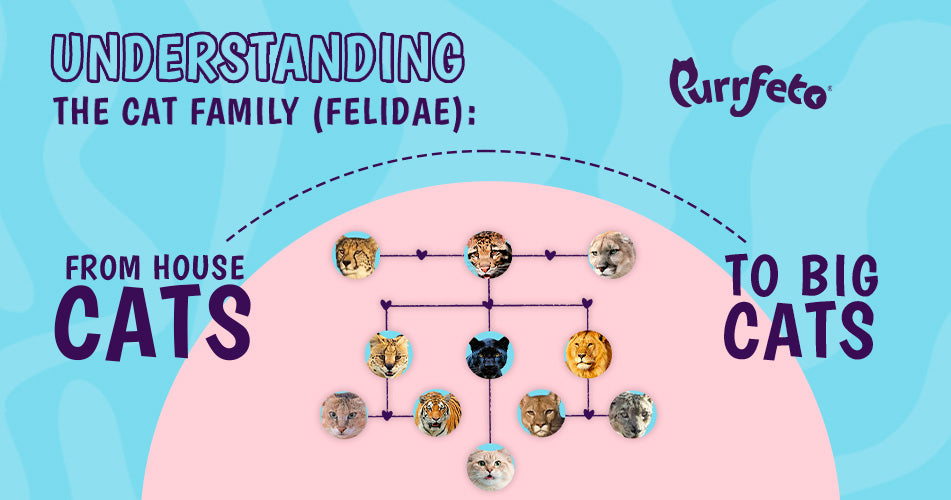
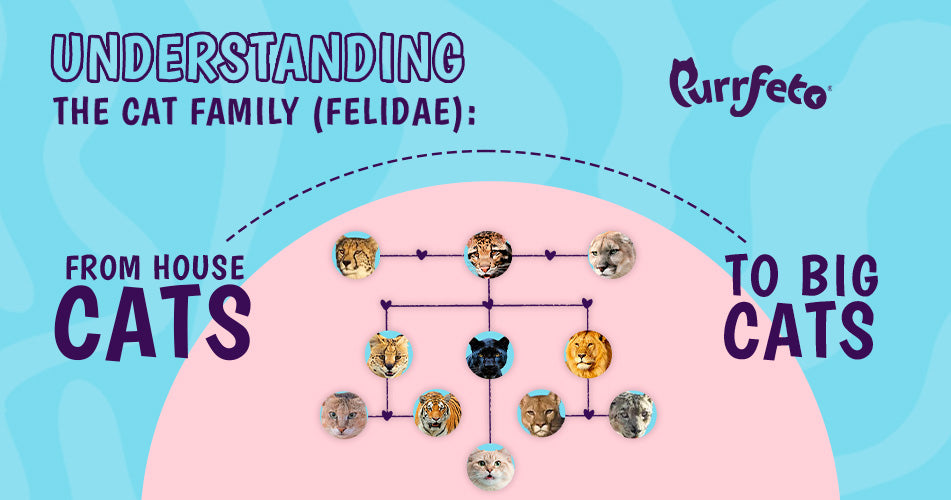
When you watch a house cat crouch before pouncing on a toy, it might remind you of a lion in the grass. That is not imagination. It is an inheritance. The cat family has grown into one of the most agile and powerful lineages in the animal world [across continents and species]. From jungle-dwelling tigers to window-sitting pets, they all belong to the same biological group, i.e., Felidae.
Every flick of the tail and every silent step tell a story written over millions of years. To understand your pet cat better, you must explore its roots. Because beneath the soft fur and playful nudges lies a legacy of survival, adaptation, and extraordinary skill. Let us dive into the structure of the Felidae family, how evolution turned wild cats into companions, and why nutrition matters just as much today.
What is the Felidae Family?

Felidae is the scientific name for what we commonly call the cat family. This group includes roughly 40 species ranging from enormous predators like tigers to sleek tree-climbing wildcats. It also includes every domestic cat around the world. That is what makes this group so unique. Despite major differences in size and habitat, all felids share traits that link them through evolution.
Members of the Felidae family have retractable claws, forward-facing eyes for precision hunting, and a strong reliance on stealth. Their bodies are built for movement. Their teeth are sharpened for slicing meat. Cats always move with purpose [be it while stalking deer or playing with a feather]. That sense of purpose connects a lion in Africa to a kitten curled on your bed.
Big Cat Families

When people talk about big cats, they are usually referring to lions, tigers, leopards, jaguars, snow leopards, and clouded leopards, which belong to the Pantherinae subfamily within Felidae. One key distinction is their ability to roar, thanks to specialised throat structures. They hunt large prey, guard territories, and live in specific environments that match their physical strength.
Lions live in groups and thrive in grasslands. Tigers are solitary and stalk through forests. Leopards adapt to cliffs, deserts, and even cities. Each one is part of the greater cat family but is shaped by its land and needs.
Though the setting differs, their instincts are familiar. They groom to stay clean, sharpen claws on surfaces, and protect their space. These traits are echoed in the smaller cats we keep at home.
From Wild to Home: Evolution of Domestic Cats
The shift from wildcat to house cat began thousands of years ago. As human farming began, grain storage attracted rodents. Wildcats followed. Without cages or breeding programmes, cats began living near people simply because it helped them survive.
The friendlier, more adaptable cats stuck around. Over generations, their bodies and behaviours softened. But not by much. Domestic cats still stalk, pounce, and mark territory. They still enjoy independence and hide when threatened. The wildness did not disappear. It merely adjusted to fit within our walls.
Are There Giant Domesticated Cats?

While tigers are not moving in any time soon, there are breeds that seem almost mythical in size. These are sometimes called giant domesticated cats, though they remain far smaller than their wild cousins.
Maine Coons, Ragdolls, and Norwegian Forest Cats are known for their large frames, fluffy coats, and gentle temperaments. They are playful and affectionate but still chase shadows across the floor with the precision of a leopard in the wild. Their size may impress, but their instincts are ancient and familiar.
These breeds show that even within domestication, variation thrives. Size grows, personality develops, but the connection to the Felidae family remains visible in every movement.
Similarities Between Big Cats and House Cats
The differences between a jungle cat and a lap cat are clear. Yet their similarities are even more revealing.
- Grooming: Whether it is a lion licking its paw or a domestic tabby cleaning its ears, grooming serves hygiene and bonding.
- Hunting Instincts: Playful pouncing is not just for fun. It is a trace of hunting behaviour that kept ancestors alive.
- Communication: Both big and small cats use body language, vocal cues, and scent to communicate. A flattened ear or flicking tail means more than words ever could.
These connections are not accidental. They are evolutionary threads. Recognising them helps cat parents respect the emotional and physical needs of their pets.
Feeding the Modern Domestic Cat

While the instincts remain, the food supply has changed completely. House cats no longer chase prey. Instead, they rely on humans for every meal. That shift means nutrition must be intentional. A wild cat’s diet included raw meat, bones, and organs. It was rich in moisture and protein. But many modern foods lack this balance. That is where thoughtful brands step in.
Purrfeto Wet Cat Food offers moisture-rich meals that echo the hydration levels cats once obtained from natural prey. With around 87% moisture and balanced nutrition, it supports daily hydration and urinary health while helping maintain overall well-being. When cats experience stress, Purrfeto’s premium recipes can help ease digestion and support appetite, making mealtimes more comfortable. Enriched with omega-rich oils containing omega-3 and omega-6 fatty acids, taurine, and essential vitamins, it contributes to healthy digestion, stronger immunity, and soft, healthy skin and coat
On the other hand, Purrfeto Dry Cat Food supports daily nutritional consistency. It is designed for routine and convenience while being crafted with high-quality proteins and essential nutrients that align with a cat’s natural dietary needs. It supports immune function and promotes healthy digestion without adding unnecessary fillers or irritants, with the inclusion of psyllium husk to help prevent hairballs and support digestion. Additionally, it may help reduce the risk of urinary tract disorders (UTDs) by up to 40%, helping cats stay comfortable and healthy every day. Together, both formats create a balanced feeding routine that respects your cat’s biology. When you feed with purpose, you honour the instincts your cat was born with, supporting not just their appetite but their long-term wellbeing.
Conclusion
The journey from predator to pet is long, but not disconnected. Your cat may nap by the window, but its DNA remembers the wild. It remembers the chase. It remembers the silence. The cat family is powerful, ancient, and beautifully complex. Whether you admire the roar of a tiger or the soft purr beside your arm, you are witnessing evolution in motion. Your home may not look like a forest, but your cat still carries it within.
FAQs
What is the family name for cats/What is the scientific name for the cat family?
The cat family is scientifically named Felidae (and its members are known as felids).
How did the cat family evolve over time?
Felids evolved from early carnivoran ancestors millions of years ago into agile, specialized predators with retractable claws and keen hunting instincts. Domestic cats specifically evolved thousands of years ago when wildcats began living near human farming settlements to hunt rodents, gradually softening their behavior to live alongside humans while retaining their wild predatory instincts.
Does a fox belong to the cat family?
No. Foxes belong to the dog family (Canidae), not the cat family (Felidae).
 Back to Blogs


