
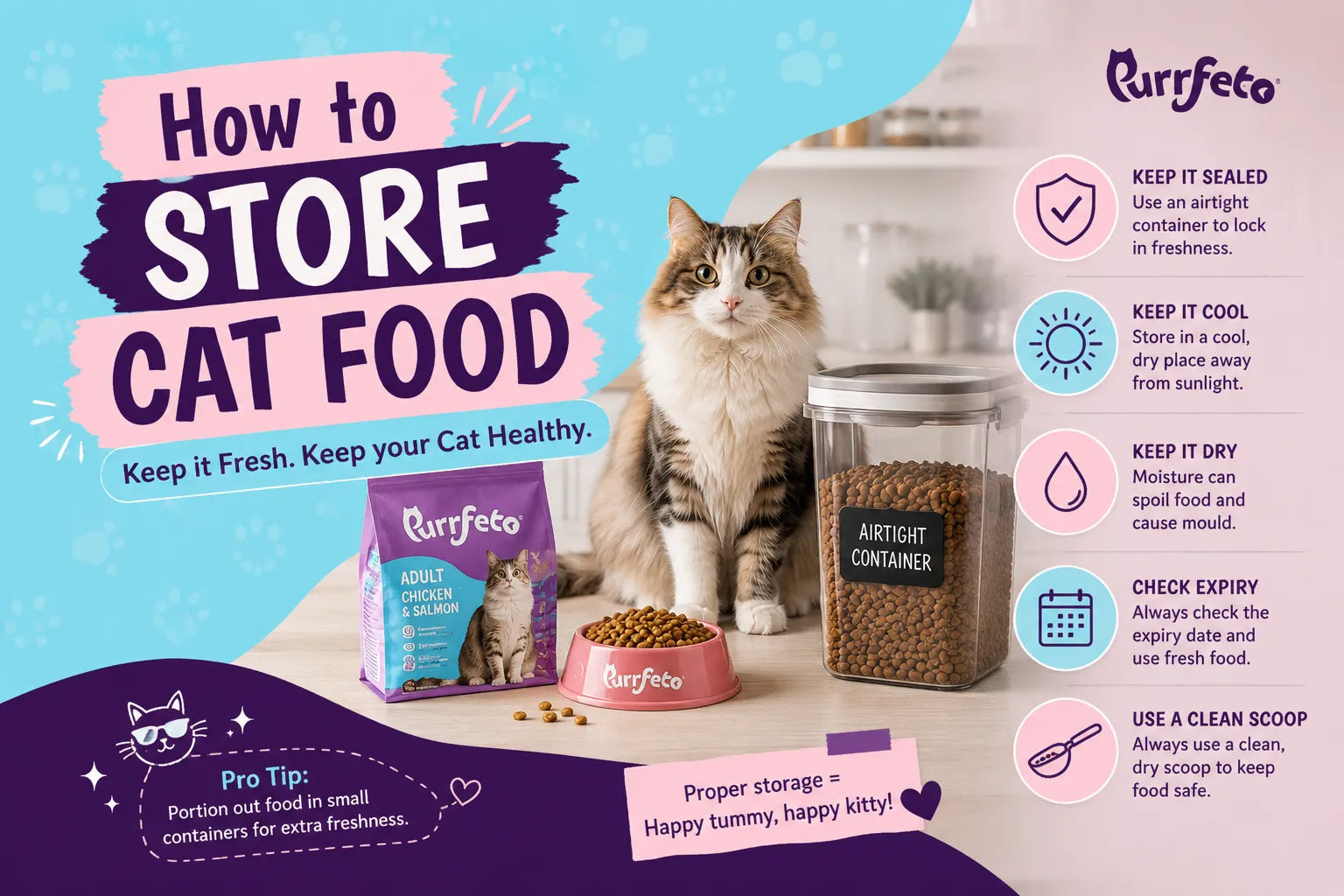
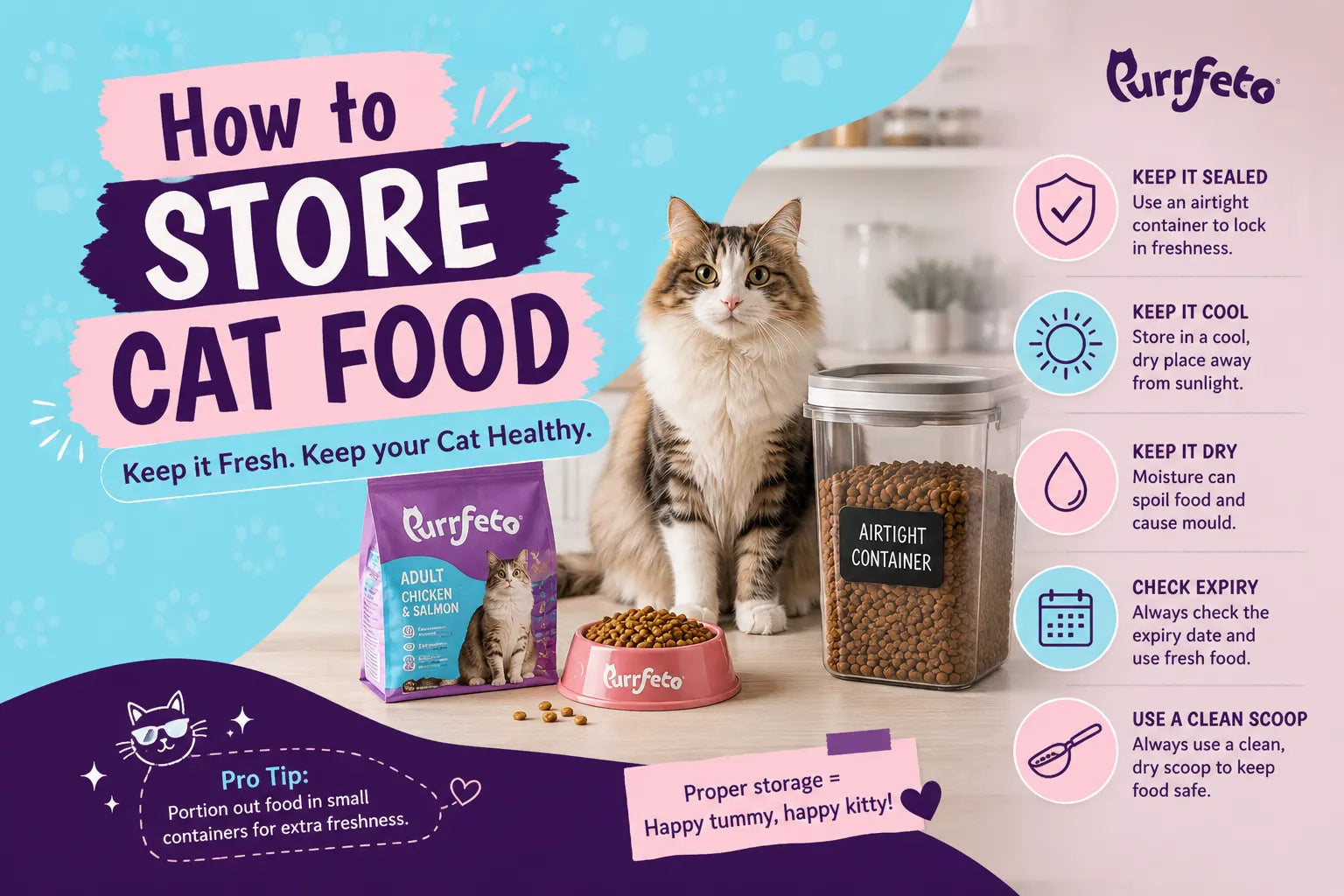
Proper cat food storage starts with keeping dry kibble in its original bag, rolling the top down tightly, and placing the whole bag inside a clean, dry, airtight container. Store it indoors below 27°C, away from moisture. Refrigerate opened wet food pack immediately, use it within 3 days, and clear the bowl within an hour. In humid Indian months, buy a pack size your cat can finish in 3 to 4 weeks rather than a bulk pack that sits open for months.
Why cat food storage matters more than most of us think

Most Indian cat parents research food brands obsessively and then undo that effort in the kitchen. The bag gets rolled once, shoved behind the atta dabba, and reopened twice a day for six weeks.
Here is what happens in that gap.
Cat food is high in fat, and fat is the first thing to break down. Because cat and dog foods tend to be rich in essential fats, oxidation is a common problem, especially in kibble, and rancidity cannot be reversed once it starts, only slowed. Fish based recipes deserve extra care, because fish oils are especially prone to spoilage as they oxidise significantly faster than other oils, and rising storage temperatures accelerate the process further.
The FDA recommends storing dry pet food in a cool, dry place under 80°F (roughly 27°C) to protect nutrient stability and prevent fats from oxidizing.
And this is not a niche concern anymore. India's pet cat population stood at nearly 3.6 million in 2023 and is projected to reach around 5.76 million by 2028. More cats, more kibble sitting open in warm kitchens.
The India problem: our weather is working against the bag

Most parts of India experience high humidity for a major part of the year, making dry pantries rare. Across coastal cities and high-moisture regions (including Mumbai, Chennai, Kolkata, Kochi, Goa, and coastal Gujarat), average relative humidity ranges from 75% to nearly 90% during peak monsoon months.
Two things happen at those numbers.
Mould and aflatoxin risk climbs: Aspergillus moulds infest stored grains under conditions of appropriate moisture, specifically grain moisture above 15% and relative humidity above 75%, combined with warm temperatures, and aflatoxins target the liver in cats and dogs. The frightening part is that you cannot always see it. The FDA notes that aflatoxins can be present even when there is no visible mould on the pet food, and signs of poisoning include sluggishness, loss of appetite, vomiting, jaundice, unexplained bruising and diarrhoea.
Storage mites multiply: In a controlled study, ten commercial dry foods were opened and stored for six weeks, and after five weeks at 23.2°C and 71% relative humidity, mites were found in nine of the ten diets. Those conditions describe an ordinary Indian home in July. A broader review confirmed that storage mites do not chew through packaging; they enter through defective seals, and dry pet food should be kept indoors and sealed to reduce contamination risk. These mites are a known trigger for itching and skin flare ups in sensitive pets.
So the goal is simple: keep air out, keep moisture out, keep the seal honest.
How to store dry cat food: the bag-in-bin method
This is the method veterinary and regulatory guidance converges on, and it takes ten seconds a day.
1. Keep the food in its original bag: Always, cat food bags are engineered with barrier layers that slow oxidation. A bare steel dabba or plastic bin has no such lining. The FDA advises storing pet food in the original container or bag so the UPC code, lot number, product name, manufacturer, and best-by date stay accessible, and if you want to use a storage container, put the entire bag inside it rather than pouring the kibble in loose.
2. Press the air out and roll the top down tightly: Use a strong clip or a bag sealer. Roll, do not fold loosely.
3. Place the sealed bag inside an airtight container: The bin blocks humidity, ants, and curious paws. The bag protects the food. You need both.
4. Never pour a new bag on top of old crumbs: Residual oil and dust at the bottom of a bin turn rancid and contaminate fresh food. Empty the container completely, wash it with hot water and soap, and dry it fully before the next bag goes in. Even a little trapped moisture is enough to start mold.
5. Save the label: If a recall or a quality issue ever occurs, the batch number is the only thing that helps. The FDA notes that fewer than half the pet food complaints it receives include the lot number (Source: FDA).
6. Skip the fridge for kibble: Moving kibble in and out of a cold fridge causes condensation, which is exactly what you are trying to avoid.
A note on containers, since Indian kitchens run on steel
Steel dabbas are excellent for keeping ants and humidity out, but there is a nuance worth knowing: metals can speed up oxidation in food substrates they come into direct contact with. This is not an argument against steel. It is an argument for the bag-in-bin method, where the food never touches the container at all. Steel, food-grade plastic, or glass all work well when the original bag sits inside them.
Where to keep it, and five places to stop keeping it

Good spots: an interior kitchen cabinet, a bedroom cupboard shelf, a storeroom away from external walls, or any cool, dark, dry corner indoors.
Avoid these:
-
The balcony or utility area: Direct heat, monsoon splash, and open air.
-
Under the sink: Pipe condensation and leaks make this one of the dampest spots in an Indian home.
-
On top of the fridge: The compressor vents warm air upward.
-
Beside the stove or oven: Heat and cooking steam.
-
Against an exterior wall that gets seepage: Common in older buildings during monsoon.
How long does cat food actually last once opened?
|
Type |
Once opened, use within |
Non negotiables |
|
Dry kibble |
4 to 6 weeks is ideal in Indian conditions. Purina's guidance allows two to three months if stored properly |
Original bag, sealed, inside an airtight bin, indoors |
|
Wet pouch or can, refrigerated |
3 days once sealed and refrigerated |
Covered tightly, fridge at 4°C or below |
|
Wet food already served in the bowl |
1 hour, less in a hot room |
Discard; do not re-refrigerate |
|
Unopened packs |
Until the printed best before date |
Store cool and dry, in undamaged packaging |
This matters because most people underestimate how long a bag stays open. In a household pet food storage survey of over 1,500 pet owners, most dogs and cats took a minimum of four weeks to finish an entire bag, and while 43.5% of owners used a storage container, 79.5% of those were plastic bins.
Buy the pack size your cat can actually finish
This is the single highest impact change you can make, and it costs nothing.
A 7kg bag looks economical. But if your single cat takes four months to finish it, you are feeding progressively older, more oxidised food for the last two months, and paying for nutrition that has already degraded. In monsoon, that maths gets worse.
Work backwards from your cat's daily intake:
-
One cat, humid city: a 1.2kg pack finished in 3 to 4 weeks is the sweet spot. Purrfeto's Adult Dry Cat Food with Chicken & Salmon 1.2kg and Chicken & Sardine 1.2kg sit in this range, and for growing cats there is Kitten Dry Food with Chicken & Ocean Fish 1.2kg.
-
Two or three cats, or a drier city like Delhi, Pune, or Bengaluru in winter: a 3kg pack will move fast enough to stay fresh.
-
Multi-cat homes and community feeders: the 7kg pack makes sense only if consumption is genuinely high. Decant a week's worth into a smaller sealed container and leave the main bag closed rather than opening the big bag twice daily.
-
Travel, trials, or testing a new flavour: 100g packs mean nothing sits open and nothing gets wasted if your cat turns up her nose.
Purrfeto's range is formulated for all cats and comes in 100g, 1.2kg, 3kg and 7kg across chicken and salmon, chicken and sardine, chicken and ocean fish, and chicken and rice, so you can match the pack to your household instead of the other way around. The range is built around taurine, omega fatty acids, and digestive fibres for kittens and adults. You can compare all sizes on the Purrfeto best sellers page.
Storage is not only about containers. It is about not asking a bag to stay fresh longer than it was designed to.
How to store wet cat food, pouches, and leftovers

Unopened pouches and cans: store at room temperature in a cool, dry place, away from direct sunlight. No fridge needed until opened.
Opened wet food: the FDA recommends promptly refrigerating or discarding unused or leftover canned and pouched pet food, covering it tightly, and keeping the refrigerator at 40°F, roughly 4°C, or below. Transfer leftovers into a small airtight box rather than leaving an open can in the fridge, and use within 3 days.
Food in the bowl: Most veterinary guidelines recommend discarding wet food left out for more than an hour. In warm or humid weather, discard any uneaten food even sooner to prevent spoilage.
Serve it at room temperature: Straight from the fridge, wet food loses aroma, and cats eat with their nose first. Let it sit out for ten minutes before serving, and never microwave it into hot spots.
The cleanest fix is portion size: Single-serve 80g pouches remove the leftover problem entirely, which is why they suit Indian homes with limited fridge space. Purrfeto's wet range includes Adult Wet Food with Mackerel in Gravy 80g, Tuna Platter in Jelly 80g, Ocean Fish in Gravy 80g and, for kittens, Ocean Platter in Jelly 80g. One pouch, one meal, nothing left to store.
How to Prevent Ants From Cat Food
Ask any Indian cat parent what ruins more food than humidity, and the answer is ants. A single trail found overnight can write off a full bowl, and cats will refuse food an ant has walked through.
Ants find food by laying chemical trails. That means two jobs: block access, and erase the trail so the next scout does not repeat the route.
What works
1. Build a water moat: The most reliable, cat-safe method. Place the food bowl inside a slightly larger shallow tray or thali with about half an inch of water in it. Ants cannot cross water. Leave a clear gap between the bowl edge and the tray edge, and make sure the bowl is not touching a wall, since ants will use the wall as a bridge.

2. Break the pheromone trail properly: Sweeping is not enough. Wipe the feeding area and the floor around it with soapy water or a mild vinegar solution to remove the scent path. If you only remove the ants, more will follow the same trail within hours.
3. Feed on a schedule instead of free feeding: Leaving kibble out all day is an open invitation. Serve measured meals, then lift and wash the bowl.
4. Seal storage properly: An airtight bin with the bag inside is your first line of defence. A rolled bag alone will not stop ants; they get in through the tiniest fold gap.
5. Elevate and isolate: Raised feeders help. So does moving the feeding station away from windows, drains, plant pots, balcony doors, and kitchen platform corners where trails originate.
6. Wipe up spills immediately: Wet food splashes and dry crumbs under the bowl are what draw the first scout.
7. Choose smooth bowls: Stainless steel or ceramic beats scratched plastic, which traps food residue and odour in micro grooves.
8. Seal the entry point: If you can trace where the trail enters, caulking that crack solves the problem permanently.
What to avoid, especially around cats
This part matters, because a lot of popular ant hacks are unsafe for felines specifically.
Essential oils are not a cat-safe repellent: Peppermint, citrus, tea tree, eucalyptus, clove, cinnamon, and pine oil are all commonly suggested online. VCA Animal Hospitals lists cinnamon, citrus, pennyroyal, peppermint, pine, sweet birch, tea tree, wintergreen, and ylang ylang among oils poisonous to cats, absorbed both orally and through the skin, and cats are particularly sensitive because they have fewer of the liver enzymes needed to metabolise them. Pet Poison Helpline confirms cats are highly sensitive to phenols and phenolic compounds found in many essential oils, with higher concentrations posing greater risk. Do not spray these near a feeding station.
Skip chilli powder, camphor, naphthalene balls and strong chemical sprays anywhere near where your cat eats, sleeps or walks. Cats groom their paws, so anything on the floor ends up in their mouth.
If you use ant gel baits or traps, place them well away from feeding and resting areas, ideally inside a cabinet or behind an appliance where your cat cannot reach, and follow the label. A water moat is safer and needs no chemistry at all.
How to tell if cat food has gone bad

Your cat usually notices before you do. Sudden fussiness with a food she previously loved is a signal worth taking seriously, not a personality quirk.
Check for:
-
A sharp, oily, paint-like, or stale smell instead of the usual aroma
-
Kibble that has gone soft, sticky, clumped, or looks dull
-
Any visible fuzz, white powder or discoloration
-
Fine dust or movement in the bag, which can indicate mite activity
-
Wet food with a sour smell, a dried crust or colour change
-
Any tear, pinhole or broken seal in the packaging
When in doubt, throw it out. And if your cat shows lethargy, appetite loss, vomiting, yellowing of the gums or eyes, or unusual bruising after eating, stop the food, keep the packet with its batch number, and see a vet. The FDA advises pet owners who suspect contaminated food to stop feeding it immediately and contact a veterinarian.
Extra situations Indian cat parents actually face
Power cuts: Keep the fridge door shut. Refrigerated wet food is generally fine through a short outage, but if the fridge has been off for several hours in summer heat, discard opened wet food rather than gambling.
Travel and boarding: Send 100g packs or pre portioned sealed pouches rather than a scooped bag. Portioned packs also stop a well meaning caretaker from overfeeding.
Feeding community cats: Store the main stock indoors, carry out only what you will serve, and use a raised, ant moated feeding plate. Never leave an open bag outside, where humidity and rain reach it fast.
Monsoon specifically. Move to smaller pack sizes for those months; check the bag seal every single time. Keep a silica gel sachet inside the outer container (never placed directly in the food bag or left loose where a cat could accidentally ingest it).
Do not forget the bowl and the scoop
Storage hygiene fails at the last step for most people. The FDA advises washing pet food bowls and scooping or measuring utensils with soap and hot water after each use, and not using the pet's food bowl as a scoop. Use a dedicated scoop, keep it outside the food bag between uses, and wash your hands before and after handling food.
Your 60 second storage checklist
-
Food stays in its original bag, always
-
Bag rolled tight and clipped after every meal
-
Whole bag sits inside a clean, dry, airtight container
-
Stored indoors, cool, dark, below 27°C, away from damp walls
-
Container washed and fully dried between bags, never topped up
-
Pack size matched to 3 to 4 weeks of consumption
-
Opened wet food refrigerated, covered, used within 3 days
-
Bowl cleared within an hour and washed daily
-
Water moat under the bowl during ant season
-
Batch number and best before date saved
FAQs
Can you store cat food in the fridge or freezer?
Do not refrigerate kibble, as temperature swings cause condensation and moisture is the main enemy. Opened wet food must be refrigerated at 4°C or below and used within three days (Source: FDA).
Is it fine to pour kibble directly into a container?
It is second best. The FDA recommends putting the entire bag inside the container instead, and if you must pour it loose, the container should be clean, dry, and tightly lidded, and you should save the label details separately.
How long does dry cat food last after opening?
Purina's guidance is two to three months when properly stored, but in humid Indian conditions, finishing within four to six weeks is the safer target.
Why is your cat suddenly refusing food she used to love?
Oxidised fat changes the smell before it changes the look. Open a fresh pack and compare the aroma. If the new one smells noticeably better, the old one has turned.
Are ants in cat food dangerous?
The ants themselves are rarely toxic, but contaminated food should be discarded, and an ant trail signals that your storage or cleaning routine has a gap. Fix the trail and the seal; do not just scoop out the ants.
Does the pack size really affect freshness?
Yes. A bag that stays open for four months is exposed to air and humidity every single day. Matching pack size to consumption is the cheapest freshness upgrade available.
*This article is for general guidance. For medical concerns, feeding changes, or if your cat shows signs of illness, consult your veterinarian.
 Back to Blogs


