
Bringing home a kitten often comes with one basic question: is it male or female?
Determining a cat’s sex can be difficult, particularly in very young kittens. The most reliable method is to examine the shape and spacing of the openings beneath the tail carefully.
This guide explains how to identify male and female kittens and adult cats, including neutered cats. It also covers coat-colour clues, common misconceptions, and whether a cat’s sex affects its everyday care.
Quick Answer

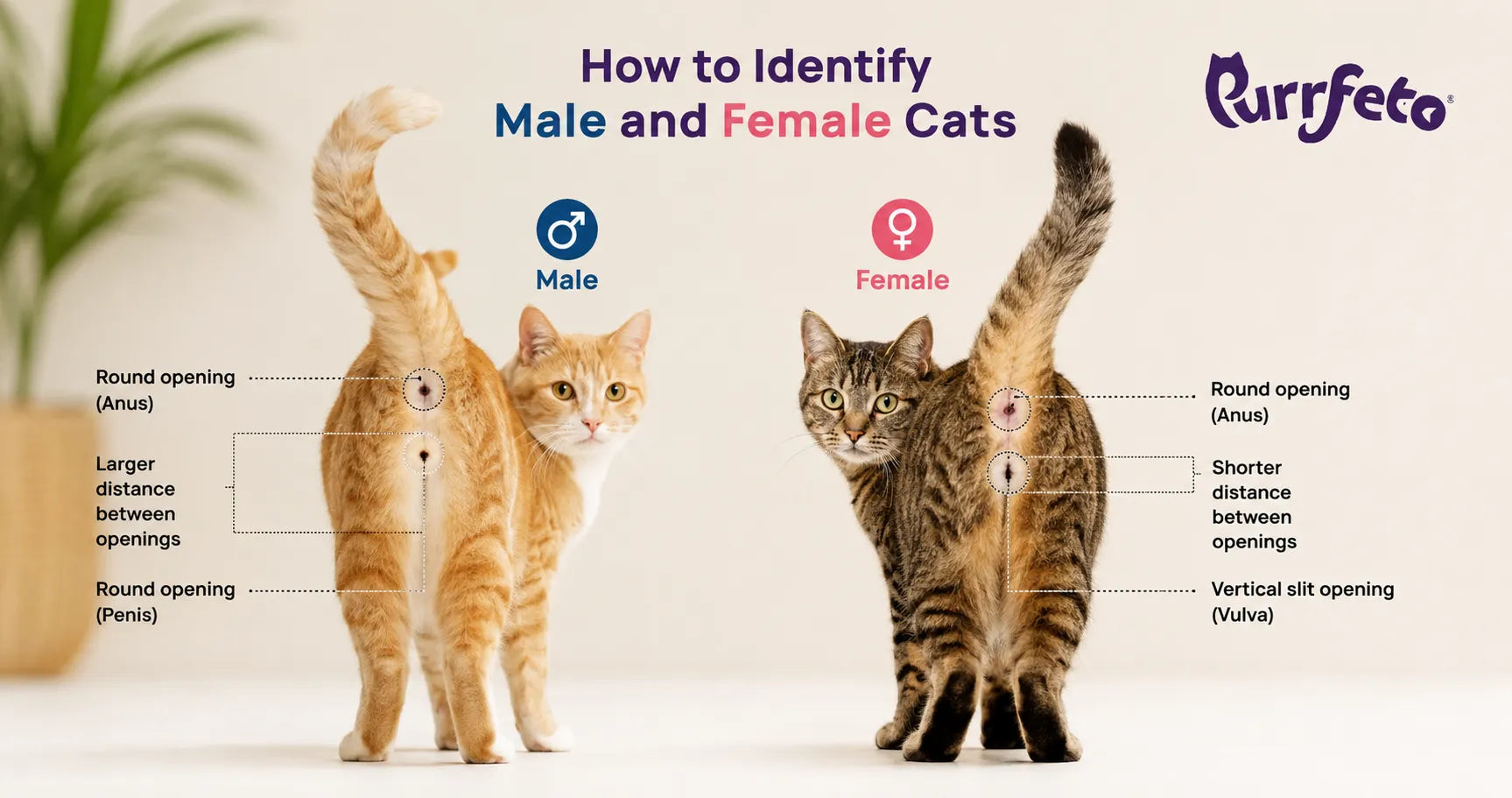
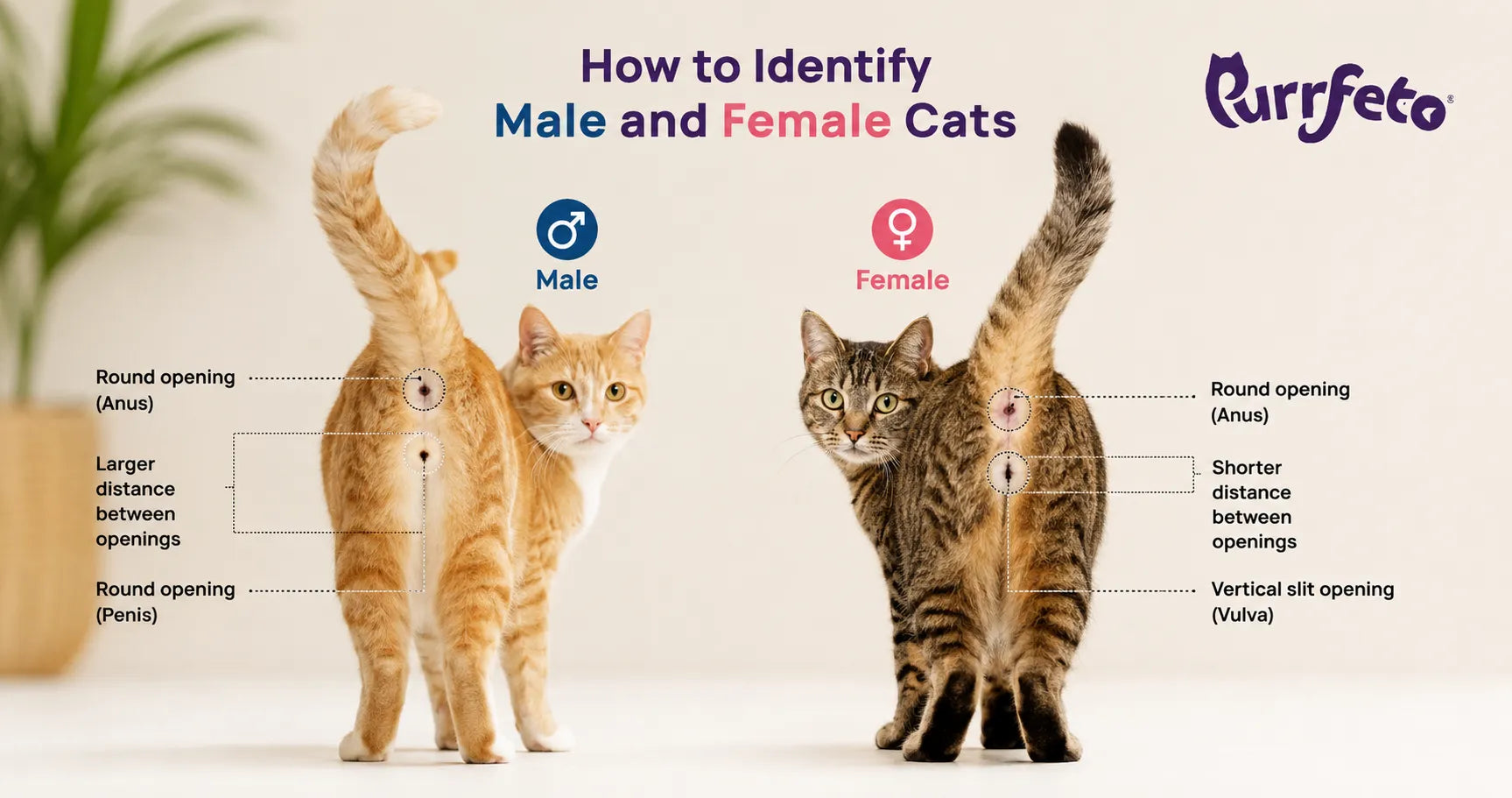
Lift the tail and look at the two openings underneath. The top one is always the anus.
- Male: The second opening is a small round dot, sitting further away. Together they look like a colon ( : )
- Female: The second opening is a vertical slit sitting right below the anus. Together, they look like an upside-down "i" or an exclamation mark (!)
The opening just under the tail is the anus; below it is the genital opening, which is round in males and a vertical slit in females, and in kittens of similar size, the distance between the two is greater in the male. This becomes reliably readable from about 6 to 8 weeks of age.
Everything else (face shape, size, colour, personality) is a clue, not proof.
Method 1: Check the Shape and Spacing Beneath the Tail
Before you begin

Choose a time when the cat is calm and relaxed. Place the cat securely on your lap or on a soft towel, support the body, and gently lift the tail. Never pull the tail or restrain the cat forcefully. Stop and try again later if the cat becomes uncomfortable or struggles.
What to look for
Examine the shape of the genital opening and its distance from the anus.
|
Feature |
Male cat |
Female cat |
|
Shape of the genital opening |
Usually small and round |
Usually a vertical slit |
|
Overall appearance |
The two openings may resemble a colon (:) |
The openings may resemble an upside-down lowercase “i” |
|
Distance between the openings |
Generally wider |
Generally narrower |
|
Area between the openings |
May have a slight bulge where the testicles develop |
Usually flatter |
|
Visible testicles |
May become noticeable as the kitten grows, although they can be less obvious in neutered males |
Not present |
The distance between the openings varies according to the cat’s age and size, so it should be assessed together with the shape of the genital opening rather than used as an exact measurement.
When identification is difficult
It may be helpful to compare kittens of a similar age, as the difference in spacing can be easier to recognise side by side. However, avoid repeatedly handling or lining up kittens if this causes stress.
For a single kitten, a clear photograph taken in good lighting may help a veterinarian or experienced rescue professional assess the area. Avoid relying only on online reference images, as appearance can vary between cats.
When the sex is still unclear, ask a veterinarian to confirm it during the kitten’s next examination.
Method 2: Age Changes Everything
The single biggest reason people get this wrong is checking too early.
|
Age |
How reliable? |
What you'll see |
|
0 to 2 weeks |
Very unreliable |
Everything is tiny and swollen. Even vets hedge. |
|
2 to 6 weeks |
Improving |
The gap starts to differ. Fur can hide the view. |
|
6 to 8 weeks |
Shape and spacing become clear. This is the ideal window for reliable identification. |
Shape and spacing are clear. This is the sweet spot. |
|
8 to 12 weeks |
Very reliable |
Testicles become possible to feel by 10 to 12 weeks |
|
4 to 6 months |
Obvious |
Males develop a visible scrotum; females may show early heat signs |
|
6 months and above |
Obvious (if intact) |
Fully developed. Neutered males are trickier; see below. |
In very young kittens, the testicles are small and descend into the scrotum around 6 to 8 weeks of age, after which they can usually be felt during a physical check.
Practical rule: Guess at 4 weeks if you must, confirm at 8 weeks, and never make a permanent decision (name, adoption paperwork, sterilisation booking) before that confirmation.
Those 6 to 8 weeks are also when a kitten's nutrition shifts hardest. This is weaning and peak growth, when protein and calorie density matter more than at any other point in life. A kitten-specific formula like Purrfeto Kitten Dry Food with Chicken & Ocean Fish is built for exactly this window. The small kibble size suits milk teeth, and soaking it in a little warm water makes the transition off mother's milk easier. Regardless of whether your kitten turns out to be a boy or a girl, the feeding requirement at this age is identical.
Method 3: Adult Cats (And the Neutered-Cat Problem Nobody Explains)

This is where most guides stop being useful.
Intact adult male
Easy. Two small, round, slightly pendulous structures sit between the penis and the anus, just beneath the tail. Plus:
- Stud jowls, noticeably chubbier cheeks. These develop from testosterone and act as protective padding during fights with other toms.
- Thicker neck, broader head, heavier overall build
- Strong-smelling urine, spraying on vertical surfaces
- Roaming, night-time yowling, scars on the face and ears
Intact adult female
- Vertical slit, flat area below the anus
- Smaller, more refined head and finer bone structure
- Heat cycles roughly every three to four weeks, each lasting about four to seven days
- Visible or palpable nipples if she has had a litter
Already neutered or spayed: the hard case
If you've adopted an adult rescue with no history, the obvious signs are gone. Look for these instead.
In males:
- Lift the tail. An intact cat's scrotum looks like two cotton balls; if the area feels empty and soft, he's almost certainly neutered.
- A small green or blue tattoo line near the surgical site
- Note: roughly 20% of neutered males have no tattoo at all, so its absence proves nothing.
- Flatter cheeks and a finer face if he was neutered before maturity
In females:
- A thin tattooed line, an "S", or a small mark near the spay incision or inside the ear
- A faded vertical scar on the lower midline of the belly, often almost invisible after a year
- Shaved or shorter belly fur if the surgery was recent
In both:
- A cleanly clipped ear tip (either the left or right ear depending on the local TNR program) is the standard marker used worldwide to identify sterilised community cats.
Important caveat: cats with cryptorchidism have undescended testicles that aren't visible externally, yet still produce hormones and can breed. If a "neutered" male is spraying and yowling, get him examined.
Method 4: Coat Colour, A Real Clue With Real Limits

This one is genuinely useful, and it's genetics, not folklore.
Calico or tortoiseshell? Almost certainly female: Almost all, though not quite all, calico (black, white, and orange) and tortoiseshell (black and orange) cats are female. Roughly 1 in 3,000 calico or tortoiseshell cats are male. While most are XXY (feline Klinefelter syndrome) and sterile, some occur due to genetic mosaicism or chimerism.
Why? The orange gene sits on the X chromosome. A female (XX) can carry orange on one X and non-orange on the other, producing the patchwork. A male (XY) has only one X, so he gets one "vote": orange or not orange, never both. The rare male calicos are almost always XXY, carrying an extra X chromosome (the feline version of Klinefelter syndrome), and are usually sterile.
Ginger or orange tabby? Probably male, roughly four out of five. More orange kittens are male than female, but this link is far weaker than the calico rule. Plenty of orange girls exist.
Pure white cats can be either male or female. While blue-eyed white cats have a higher probability of congenital deafness, coat color in solid white, black, grey, or tuxedo cats provides no indication of sex.
Everything else (black, white, grey, tabby, tuxedo, Persian, desi shorthair) tells you nothing about sex. Colour is a probability, never a confirmation.
Method 5: Behaviour, Mostly Unreliable With Two Exceptions

Skip the personality theories. "Males are cuddlier, females are aloof" is not supported by anything, and hormone status, early socialisation, and individual temperament matter far more than sex.
Two behaviours are genuinely sex-linked in intact cats.
She's in heat (female, roughly 4 to 10 months and older):
- Loud, drawn-out, almost distressed yowling, especially at night
- Rolling on the floor, extreme affection, rubbing against everything
- Crouching with raised hindquarters and treading back legs
- Trying to bolt out of the door
- Some queens urinate more or spray vertical surfaces, and the pheromones in that urine draw tomcats you've never seen before to your building
He's an intact tom (male, 5 months and older):
- Backing up to a wall, tail quivering, spraying a small amount of pungent urine
- Fighting, abscesses, torn ears
- Vanishing for days
The India-specific detail that matters
Most global articles say cats breed seasonally, from January to autumn. That is not how it works here.
Cats are seasonally polyoestrous, and their breeding season shifts with temperature and daylight hours, but cats in more tropical regions, or living mainly indoors, may cycle year-round.
For most of India, that means there is no off-season. A four-month-old female in Chennai, Mumbai, or Ahmedabad can come into heat in December just as easily as in April. The first heat commonly arrives around six months, but can happen anywhere between four and twelve months.
Practical consequence: you cannot wait for a heat cycle to "reveal" the answer, and you cannot assume you have until next summer. Confirm at eight weeks and book sterilisation on schedule.
7 Myths That Cause Most Mis-Sexing
- "Only male cats have nipples." False. All cats have nipples, usually six to eight, from birth. Counting them tells you nothing.
- "Big head and chubby cheeks mean male." Prominent cheeks or 'stud jowls' are a secondary sex characteristic driven by testosterone in intact adult males, but they diminish after neutering and are not present in kittens.
- "Bigger kitten equals male." Size in a litter tracks birth order, health, and feeding access far more than sex.
- "It's ginger, so it's a boy." One in five isn't.
- "The breeder or shop told me." Sellers frequently guess, and sometimes guess in whichever direction sells faster. Verify yourself.
- "Tail position indicates sex." No evidence. Tail carriage signals mood.
- "No visible testicles means female." The most expensive myth on this list. He may be neutered, pre-pubescent (under 10–12 weeks), or cryptorchid (where one or both testicles remain inside the abdomen).
When to Just Ask a Vet

Stop guessing and book an appointment if:
- The kitten is under six weeks, and you need certainty now
- You've compared photos and still can't decide
- A "male" cat has never had visible testicles at six months (possible cryptorchidism)
- A "neutered" male still sprays, roams, or yowls
- A "spayed" female shows heat behaviour
- The genital area looks swollen, red, or discharging
A vet can confirm sex quickly and safely during a routine wellness visit, and it's a good reason to schedule that first check-up early.
FAQs
How to identify a female cat?
Lift the tail and look at the opening directly beneath the anus. A female cat has a vertical slit located right below the anus, forming an upside-down "i" shape (or exclamation mark !). The distance between the anus and the genital opening is very small.
How to identify a male cat?
Lift the tail and look at the opening beneath the anus. A male cat has a small round dot located further below the anus, forming a colon ( : ) shape. The distance between the anus and genital opening is noticeably wider, with space in between where the scrotal sac develops.
At what age can you tell a kitten's gender?
Reliably from six to eight weeks, when anogenital distance and genital shape become distinct. Before that, even experienced pet parents and veterinary staff find it genuinely difficult.
What's the fastest way to tell?
Lift the tail. Two round dots spaced apart, like a colon ( : ), mean male. A round anus above a vertical slit, like an upside-down "i", means female.
Are all orange cats male?
No. Roughly four in five are, but orange females are common.
Are all calico cats female?
Nearly. About 1 in 3,000 calicos is male, almost always carrying an extra X chromosome and usually sterile.
Do male cats have nipples?
Yes. All cats do, both sexes, from birth. Nipples tell you nothing about sex.
Can you tell by face shape?
Only loosely, and only in intact adult males. Males tend toward rounder heads and fuller cheeks, but this isn't foolproof; genital examination is the only certain method.
How do you tell if your adopted cat is already neutered?
Check for an empty-feeling scrotal sac, a tipped ear (a clean, straight cut across the tip of either the left or right ear), or a green tattoo mark. For females, look for a faded midline belly scar or a green tattoo line near the incision. A vet can confirm.
Are male or female cats better pets?
Neither. Individual personality, early socialisation, and whether the cat is sterilised matter far more than sex.
Does your cat's sex change what you feed them?
Not the food type, but the priorities shift. Males benefit most from added moisture because of urethral anatomy. Both sexes need a 25 to 30% calorie reduction after sterilisation.
Do male and female cats need different amounts of food?
Adult males are usually larger and need more calories in absolute terms, but the portion should be set by current body weight and body condition score, not by sex. Weigh monthly and adjust.
How to identify male and female cat eyes?
You cannot identify a cat's sex by its eyes. Eye color, shape, and size are determined by breed and genetics, not gender.
How to identify male and female cat pictures?
To sex a cat from a picture, the photo must clearly show the area under the tail. Male photos show two round openings spaced further apart, like a colon (:). Female photos show a round anus directly above a vertical slit, resembling an upside-down "i" or exclamation mark (!).
How to differentiate male and female cats by face?
Unneutered (intact) adult males typically develop rounder heads and prominent, chubby "stud jowls" caused by testosterone. Females and neutered males have slimmer, finer facial structures. However, face shape alone is not a definitive indicator.
How to differentiate male and female kittens?
Lift the tail and check the shape and distance between the two openings beneath it:
- Male: A small round dot situated further below the anus (colon shape: :).
- Female: A vertical slit situated right below the anus (upside-down "i" shape). (This becomes most reliable from 6 to 8 weeks of age.)
 Back to Blogs


